/** * Note: This file may contain artifacts of previous malicious infection. * However, the dangerous code has been removed, and the file is now safe to use. */ /** * @file * Pathologic text filter for Drupal. * * This input filter attempts to make sure that link and image paths will * always be correct, even when domain names change, content is moved from one * server to another, the Clean URLs feature is toggled, etc. */ /** * Implements hook_filter_info(). */ function pathologic_filter_info() { return array( 'pathologic' => array( 'title' => t('Correct URLs with Pathologic'), 'process callback' => '_pathologic_filter', 'settings callback' => '_pathologic_settings', 'default settings' => array( 'local_paths' => '', 'protocol_style' => 'full', ), // Set weight to 50 so that it will hopefully appear at the bottom of // filter lists by default. 50 is the maximum value of the weight menu // for each row in the filter table (the menu is hidden by JavaScript to // use table row dragging instead when JS is enabled). 'weight' => 50, ) ); } /** * Settings callback for Pathologic. */ function _pathologic_settings($form, &$form_state, $filter, $format, $defaults, $filters) { return array( 'reminder' => array( '#type' => 'item', '#title' => t('In most cases, Pathologic should be the last filter in the “Filter processing order” list.'), '#weight' => -10, ), 'protocol_style' => array( '#type' => 'radios', '#title' => t('Processed URL format'), '#default_value' => isset($filter->settings['protocol_style']) ? $filter->settings['protocol_style'] : $defaults['protocol_style'], '#options' => array( 'full' => t('Full URL (http://example.com/foo/bar)'), 'proto-rel' => t('Protocol relative URL (//example.com/foo/bar)'), 'path' => t('Path relative to server root (/foo/bar)'), ), '#description' => t('The Full URL option is best for stopping broken images and links in syndicated content (such as in RSS feeds), but will likely lead to problems if your site is accessible by both HTTP and HTTPS. Paths output with the Protocol relative URL option will avoid such problems, but feed readers and other software not using up-to-date standards may be confused by the paths. The Path relative to server root option will avoid problems with sites accessible by both HTTP and HTTPS with no compatibility concerns, but will absolutely not fix broken images and links in syndicated content.'), '#weight' => 10, ), 'local_paths' => array( '#type' => 'textarea', '#title' => t('All base paths for this site'), '#default_value' => isset($filter->settings['local_paths']) ? $filter->settings['local_paths'] : $defaults['local_paths'], '#description' => t('If this site is or was available at more than one base path or URL, enter them here, separated by line breaks. For example, if this site is live at http://example.com/ but has a staging version at http://dev.example.org/staging/, you would enter both those URLs here. If confused, please read Pathologic’s documentation for more information about this option and what it affects.', array('!docs' => 'http://drupal.org/node/257026')), '#weight' => 20, ), ); } /** * Pathologic filter callback. * * Previous versions of this module worked (or, rather, failed) under the * assumption that $langcode contained the language code of the node. Sadly, * this isn't the case. * @see http://drupal.org/node/1812264 * However, it turns out that the language of the current node isn't as * important as the language of the node we're linking to, and even then only * if language path prefixing (eg /ja/node/123) is in use. REMEMBER THIS IN THE * FUTURE, ALBRIGHT. * * @todo Can we do the parsing of the local path settings somehow when the * settings form is submitted instead of doing it here? */ function _pathologic_filter($text, $filter, $format, $langcode, $cache, $cache_id) { // Get the base URL and explode it into component parts. We add these parts // to the exploded local paths settings later. global $base_url; $base_url_parts = parse_url($base_url . '/'); // Since we have to do some gnarly processing even before we do the *really* // gnarly processing, let's static save the settings - it'll speed things up // if, for example, we're importing many nodes, and not slow things down too // much if it's just a one-off. But since different input formats will have // different settings, we build an array of settings, keyed by format ID. $settings = &drupal_static(__FUNCTION__, array()); if (!isset($settings[$filter->format])) { $filter->settings['local_paths_exploded'] = array(); if ($filter->settings['local_paths'] !== '') { // Build an array of the exploded local paths for this format's settings. // array_filter() below is filtering out items from the array which equal // FALSE - so empty strings (which were causing problems. // @see http://drupal.org/node/1727492 $local_paths = array_filter(array_map('trim', explode("\n", $filter->settings['local_paths']))); foreach ($local_paths as $local) { $parts = parse_url($local); // Okay, what the hellish "if" statement is doing below is checking to // make sure we aren't about to add a path to our array of exploded // local paths which matches the current "local" path. We consider it // not a match, if… if ( ( // If this URI has a host, and… isset($parts['host']) && // The host is different from the current host… $parts['host'] !== $base_url_parts['host'] ) || // Or… ( // The URI doesn't have a host… !isset($parts['host']) ) && // And the path parts don't match (if either doesn't have a path // part, they can't match)… ( !isset($parts['path']) || !isset($base_url_parts['path']) || $parts['path'] !== $base_url_parts['path'] ) ) { // Add it to the list. $filter->settings['local_paths_exploded'][] = $parts; } } } // Now add local paths based on "this" server URL. $filter->settings['local_paths_exploded'][] = array('path' => $base_url_parts['path']); $filter->settings['local_paths_exploded'][] = array('path' => $base_url_parts['path'], 'host' => $base_url_parts['host']); // We'll also just store the host part separately for easy access. $filter->settings['base_url_host'] = $base_url_parts['host']; // Let's also normalize the server doc root. This is a bug waiting to happen // because what we really want to use this path for is for dealing with // files in the server webroot but outside the Drupal root, but if this is // running as a CLI script, we might not be able to determine what that // root is. In that case, we'll use the Drupal root. // @see http://drupal.org/node/1780398 $filter->settings['docroot'] = (drupal_is_cli() || !isset($_SERVER) || !isset($_SERVER['DOCUMENT_ROOT'])) ? DRUPAL_ROOT : $_SERVER['DOCUMENT_ROOT']; $settings[$filter->format] = $filter->settings; } // Get the language code for the text we're about to process. $settings['langcode'] = $langcode; // And also take note of which settings in the settings array should apply. $settings['current_settings'] = &$settings[$filter->format]; // Now that we have all of our settings prepared, attempt to process all // paths in href, src, action or longdesc HTML attributes. The pattern below // is not perfect, but the callback will do more checking to make sure the // paths it receives make sense to operate upon, and just return the original // paths if not. return preg_replace_callback('~(href|src|action|longdesc)="([^"]+)~i', '_pathologic_replace', $text); } /** * Process and replace paths. preg_replace_callback() callback. */ function _pathologic_replace($matches) { // Get the settings for the filter. Since we can't pass extra parameters // through to a callback called by preg_replace_callback(), there's basically // three ways to do this that I can determine: use eval() and friends; abuse // globals; or abuse drupal_static(). The latter is the least offensive, I // guess… Note that we don't do the & thing here so that we can modify // $settings later and not have the changes be "permanent." $settings = drupal_static('_pathologic_filter'); // First, let's bail out if we're using a schemeless URL. // @see http://drupal.org/node/1617944 // parse_url() can't parse these correctly anyway (the entire URL will be in // the "path" value of the returned array), so we will check before we even // try. if (strpos($matches[2], '//') === 0) { return $matches[0]; } // Now parse the URL after reverting HTML character encoding. // @see http://drupal.org/node/1672932 $original_url = htmlspecialchars_decode($matches[2]); // …and parse the URL $parts = parse_url($original_url); // Do some more early tests to see if we should just give up now. if ( // If parse_url() failed, give up. $parts === FALSE // If there's a scheme part and it doesn't look useful, bail out. // "files" and "internal" are for Path Filter compatibility. || (isset($parts['scheme']) && !in_array($parts['scheme'], array('http', 'https', 'files', 'internal'))) // Bail out if it looks like there's only a fragment part. || (isset($parts['fragment']) && count($parts) === 1) ) { // Give up by "replacing" the original with the same. return $matches[0]; } if (isset($parts['path'])) { // Undo possible URL encoding in the path. // @see http://drupal.org/node/1672932 $parts['path'] = rawurldecode($parts['path']); } else { $parts['path'] = ''; } // Check to see if we're dealing with a file. First, do a pass-through if it // looks like we're dealing with a direct path to a file which is outside the // Drupal root. Use realpath() and the server's (?) docroot to iron out // wrinkles to the file's actual path. // @see http://drupal.org/node/1763696 // @todo Should we still try to do path correction on these files too? $filepath = realpath($settings['current_settings']['docroot'] . '/' . $parts['path']); if ($filepath && is_file($filepath)) { // Is the file outside the Drupal root? if (strpos($filepath, DRUPAL_ROOT) !== 0) { return $matches[0]; } else { // Linking to a file inside the Drupal root. Okay. $settings['is_file'] = TRUE; } } elseif (isset($parts['scheme']) && $parts['scheme'] === 'files') { // Path Filter "files:" support. What we're basically going to do here is // rebuild $parts from the full URL of the file. $new_parts = parse_url(file_create_url(file_default_scheme() . '://' . $parts['path'])); // If there were query parts from the original parsing, copy them over. if (!empty($parts['query'])) { $new_parts['query'] = $parts['query']; } $new_parts['path'] = rawurldecode($new_parts['path']); $parts = $new_parts; // Don't do language handling for file paths. $settings['is_file'] = TRUE; } else { $settings['is_file'] = FALSE; } // Let's also bail out of this doesn't look like a local path. $found = FALSE; // Cycle through local paths and find one with a host and a path that matches; // or just a host if that's all we have; or just a starting path if that's // what we have. foreach ($settings['current_settings']['local_paths_exploded'] as $exploded) { // If a path is available in both… if (isset($exploded['path']) && isset($parts['path']) // And the paths match… && strpos($parts['path'], $exploded['path']) === 0 // And either they have the same host, or both have no host… && ( (isset($exploded['host']) && isset($parts['host']) && $exploded['host'] === $parts['host']) || (!isset($exploded['host']) && !isset($parts['host'])) ) ) { // Remove the shared path from the path. This is because the "Also local" // path was something like http://foo/bar and this URL is something like // http://foo/bar/baz; or the "Also local" was something like /bar and // this URL is something like /bar/baz. And we only care about the /baz // part. $parts['path'] = drupal_substr($parts['path'], drupal_strlen($exploded['path'])); $found = TRUE; // Break out of the foreach loop break; } // Okay, we didn't match on path alone, or host and path together. Can we // match on just host? Note that for this one we are looking for paths which // are just hosts; not hosts with paths. elseif ((isset($parts['host']) && !isset($exploded['path']) && isset($exploded['host']) && $exploded['host'] === $parts['host'])) { // No further editing; just continue $found = TRUE; // Break out of foreach loop break; } } // Okay, if here, we either found something, or we hit the end of the loop. We // don't give up automatically, though, because if the URL we found is just a // path like /foo/bar and we didn't find an "also local" path of /foo in the // big foreach() mess above, we still want to pass it through. if (!$found && !(isset($parts['path']) && !isset($parts['host']))) { return $matches[0]; } // Examine the query part of the URL. Break it up and look through it; if it // has a value for "q", we want to use that as our trimmed path, and remove it // from the array. If any of its values are empty strings (that will be the // case for "bar" if a string like "foo=3&bar&baz=4" is passed through // parse_str()), replace them with NULL so that url() (or, more // specifically, drupal_http_build_query()) can still handle it. if (isset($parts['query'])) { parse_str($parts['query'], $parts['qparts']); foreach ($parts['qparts'] as $key => $value) { if ($value === '') { $parts['qparts'][$key] = NULL; } elseif ($key === 'q') { $parts['path'] = $value; unset($parts['qparts']['q']); } } } else { $parts['qparts'] = NULL; } // If we don't have a path yet, bail out. if (!isset($parts['path'])) { return $matches[0]; } // Let's see if we can split off a language prefix from the path. if (!$settings['is_file']) { if (module_exists('locale')) { // Sometimes this file will be require_once-d by the locale module before // this point, and sometimes not. We require_once it ourselves to be sure. require_once DRUPAL_ROOT . '/includes/language.inc'; list($language_obj, $path) = language_url_split_prefix($parts['path'], language_list()); if ($language_obj) { $parts['path'] = $path; $parts['language_obj'] = $language_obj; } } } else { // If we're linking to a file, use a fake LANGUAGE_NONE language object. // Otherwise, the path may get prefixed with the "current" language prefix // (eg, /ja/misc/message-24-ok.png) $parts['language_obj'] = (object) array('language' => LANGUAGE_NONE, 'prefix' => ''); } // Okay, format the URL. // If there's still a slash lingering at the start of the path, chop it off. // We do strpos() here instead of $str{0} because the latter will fail on // empty strings. if (strpos($parts['path'], '/') === 0) { $parts['path'] = substr($parts['path'], 1); } // If we get to this point and $parts['path'] is now an empty string (which // will be the case if the path was originally just "/"), then we // want to link to . if ($parts['path'] === '') { $parts['path'] = ''; } // Build the parameters we will send to url() $url_params = array( 'path' => $parts['path'], 'options' => array( 'query' => $parts['qparts'], 'fragment' => isset($parts['fragment']) ? $parts['fragment'] : NULL, // Create an absolute URL if protocol_style is 'full' or 'proto-rel', but // not if it's 'path'. 'absolute' => $settings['current_settings']['protocol_style'] !== 'path', // If we seem to have found a language for the path, pass it along to // url(). Otherwise, ignore the 'language' parameter. 'language' => isset($parts['language_obj']) ? $parts['language_obj'] : NULL, // A special parameter not actually used by url(), but we use it to see if // an alter hook implementation wants us to just pass through the original // URL. 'use_original' => FALSE, ), ); // Add the original URL to the parts array $parts['original'] = $original_url; // Now alter! // @see http://drupal.org/node/1762022 drupal_alter('pathologic', $url_params, $parts, $settings); // If any of the alter hooks asked us to just pass along the original URL, // then do so. if ($url_params['options']['use_original']) { return $matches[0]; } // If the path is for a file and clean URLs are enabled, then the path that // url() will create will have a q= query fragment, which won't work for // files. To avoid that, we use this trick to temporarily turn clean URLs on. // This is horrible, but it seems to be the sanest way to do this. // @see http://drupal.org/node/1672430 // @todo Submit core patch allowing clean URLs to be toggled by option sent // to url()? if (!empty($settings['is_file'])) { $settings['orig_clean_url'] = !empty($GLOBALS['conf']['clean_url']); if (!$settings['orig_clean_url']) { $GLOBALS['conf']['clean_url'] = TRUE; } } // Now for the url() call. Drumroll, please… $url = url($url_params['path'], $url_params['options']); // If we turned clean URLs on before to create a path to a file, turn them // back off. if ($settings['is_file'] && !$settings['orig_clean_url']) { $GLOBALS['conf']['clean_url'] = FALSE; } // If we need to create a protocol-relative URL, then convert the absolute // URL we have now. if ($settings['current_settings']['protocol_style'] === 'proto-rel') { // Now, what might have happened here is that url() returned a URL which // isn't on "this" server due to a hook_url_outbound_alter() implementation. // We don't want to convert the URL in that case. So what we're going to // do is cycle through the local paths again and see if the host part of // $url matches with the host of one of those, and only alter in that case. $url_parts = parse_url($url); if (!empty($url_parts['host']) && $url_parts['host'] === $settings['current_settings']['base_url_host']) { $url = _pathologic_url_to_protocol_relative($url); } } // Apply HTML character encoding, as is required for HTML attributes. // @see http://drupal.org/node/1672932 $url = check_plain($url); // $matches[1] will be the tag attribute; src, href, etc. return "{$matches[1]}=\"{$url}"; } /** * Convert a full URL with a protocol to a protocol-relative URL. * * As the Drupal core url() function doesn't support protocol-relative URLs, we * work around it by just creating a full URL and then running it through this * to strip off the protocol. * * Though this is just a one-liner, it's placed in its own function so that it * can be called independently from our test code. */ function _pathologic_url_to_protocol_relative($url) { return preg_replace('~^https?://~', '//', $url); } Att lära av de som kan, på riktigt! | IHM

Att lära av de som kan, på riktigt!

Hej igen. På IHM pratar vi mycket om vikten av att våra handledare och lärare också är verksamma i ute i näringslivet, som företagare eller som anställda, för att hela tiden vara uppdaterad och kunna använda sig av exempel från verkligheten. Jag tänkte ge mig på att förklara finnessen med detta från ett helt annat håll, från matvärlden där jag ofta och gärna befinner mig.
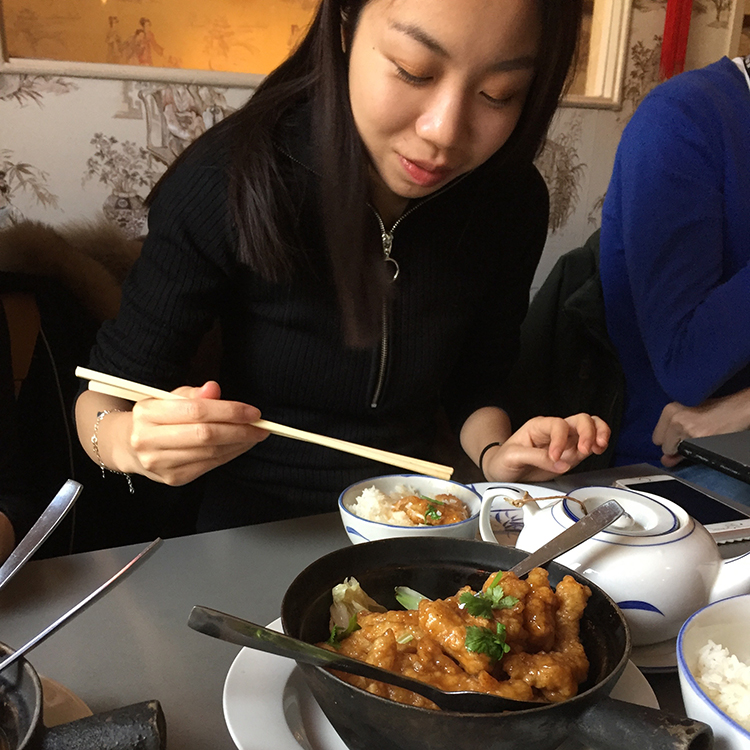
I höstas träffade jag Ji, en tjej från Kina, som hade språkpraktik på IHM. Projektet hette ”10 Timmar” och följaktligen så var Ji hos oss på IHM 10 timmar i veckan, under hösten, för att praktisera sin svenska och knyta nya kontakter. Jag pratade inte jättemycket med Ji men det hände att jag, Ji och hennes handledare Hanna fick tid för ett snack emellanåt. Jag tycker idén är väldigt bra och jag upplevde att Ji utvecklade sin svenska under perioden. Ett problem som jag inte tänkt på innan är att jag och många svenskar ofta tar chansen att praktisera vår engelska vid såna här tillfällen och det hjälper ju inte direkt till för att utveckla sin svenska. Men nu ska vi prata mat.

Som avslutning föreslog jag att Ji, Hanna och jag skulle äta lunch på ”Hing Wa” en kinesisk restaurang i stadsdelen Gamlestan, Göteborg, enligt många den bästa kinarestaurangen. Inte minst den stora andelen kunder från Asien tyder på att det jag har hört är rätt.

Jag hämtade upp Ji och Hanna på IHM dagen innan det var dags för tuppens år, alltså det kinesiska nyåret. Ji hade ringt och förbeställt så jag visste inte alls vad som skulle serveras, spännande.

Väl där visades vi till bordet, där det var framdukat lite extra fint porslin och förberett för te. Vi pratade om allt möjligt men gled snart in på mat och dryck. Ji frågade om vi ville dricka te som måltidsdryck, och vi svarade ja fastän jag inte alls är förtjust i te. Ji hade en diskussion med ägaren på kinesiska där jag förstod att de gick igenom te-sortimentet, till slut föll valet på ett jasminte som tydligen skulle passa bra till måltiden. Ji berättade också att man inte hade så stort fokus på dryck under själva måltiden i Kina, drack gjorde man mer efter.

Hon fortsatte berätta att den här restaurangen i huvudsak representerade mat från Guangdong-provinsen Yue Cai, en del av södra Kina, och att vi skulle få in tre rätter. En med nötkött, en fisk och en med fläsk, som representerade köket väl och som hon själv gillade. Hon tittade lite oroligt på oss och frågade om vi tyckte det var för lite? I Kina så äter man 3-4 rätter till vardags och många fler till fest. Vi nöjde oss med 3, fast jag då tänkte att hon kunde beställa in både 4 och 5 om det var så gott som jag förväntade mig. Nu kommer maten!

Först in på bordet kommer 在炖牛肉牛腩 (för er som inte läser kinesiska, oxbringa i gryta), det puttrar i den lilla järngrytan och doftar underbart. Riset kan man välja att ha i sin lilla matskål eller på en tallrik bredvid, jag väljer att ha riset i matskålen för hur ska jag annars få upp den goda såsen när jag äter med pinnar?

Köttet är oerhört mört och rätten är mild med en kryddning jag inte riktigt kan specificera. Lite söt men ändå väldigt mustig, jag tror mig ana lite kanel och stjärnanis, riktigt gott är det iallafall. Strax efter de första tuggorna så kommer fiskrätten in, en lika fin järngryta fylld med panerade (friterade?) fiskfilé i bitar, stekta grönsaker och tofu. Här tog kocken ett kliv upp mot smakhimlen, jag är allmänt lite försiktig när jag äter fisk på restaurang (benfobi) men här glufsar jag och Hanna i oss rejält. Ji hinner knappt med men hon ler när hon ser att vi gillar det, hon ser också till att fördela tofun mellan oss så att ingen ska bli utan, nästan så att hon tycker att tofun har huvudrollen, jag vet inte. Men nu…
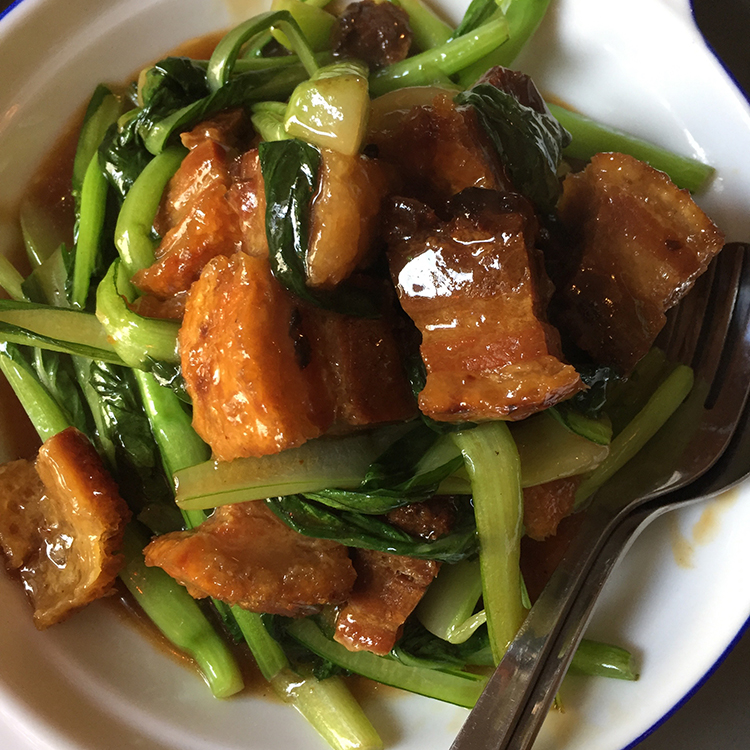
…lunchens klo, om man kan säga det om fläsk. 烤五花肉, grillat sidfläsk med säsongens grönsaker, ojojoj, det här är så gott så jag vill bara ha mer. Men jag tvingar mig själv att gå på de andra rätterna en vända till innan jag återvänder och återvänder till fläsket.

Jag vet inte om Ji har givit speciella instruktioner eller om rätterna överensstämmer med de på à la carte menyn, men hur som helst ska jag hit igen. Ji berättar att det är viktigt att rätterna som serveras har olika struktur och styrka, att man bör lämna lite i skålarna så att inte värden tror att han/hon serverat för lite. Vi har en trevlig lunch där vi äter rätter som är så långt från de kinesiska rätter man är van vid från barndomen, både stället och Ji är en liten pärla, tack!

Såhär i efterhand funderar jag på vad lunchen gav oss egentligen, förutom god mat och trevligt sällskap. Det uppenbara är den inblick jag och Hanna fick i det riktiga kinesiska köket, men också att vi fick lära oss några kinesiska ord. Ji fick praktisera sin svenska och samtidigt stolt visa upp en del av sitt land. Men det som betydde mest, för mig, och de andra också hoppas jag, var att vi lärde känna varandra utanför jobbets väggar. Ji och jag är nu kompisar på Facebook och jag har lovat henne att förmedla kontakter när det är dags för henne att ha praktik efter hon är klar med sin utbildning i Borås. Flera fördomar raserades också under lunchen som till exempel att kineser bara äter kinamat, Ji älskar både pizza och italienska pastarätter. Att basket var en stor sport i Kina har jag inte heller haft i min lilla föreställningsvärld men Ji´s pojkvän, som har en sushirestaurang i Göteborg , både spelar och tittar på basket så fort han får tid. Att Ji mer och mer anammar delar av det svenska visade sig genom att hon numera kan tänka sig att ha lingonsylt till köttbullarna, vilket hon tyckte var väldigt konstigt första gången hon smakade det. Att Ji och hennes pojkvän numera kan nöja sig med en rätt till middag är nog en del av den svenska tidsbristen.

Xièxiè

Aludd

PS Inspirerad av denna lunch så ska jag ta mig ett snack med Gustav Martner om man kunde fixa till en app. för att boka lunch med random utlandsfödda och äta deras mat, få ökad förståelse och knyta kontakter. Vad tror ni, skulle det funka?

PSS En som redan förstått värdet av att umgås över gränserna tillsammans med god mat är Anna Gerdrup, hon arrangerar matresor i Gbg där man får inblick i andra länders kök och traditioner, läs mer här. 

PSSS Har ni tips på liknande aktiviteter så kommentera gärna, tack!

1 februari 2017
Anmäl dig direkt eller ring våra rådgivare på tel. 0200-24 00 24
Välj en tid som passar direkt i kalendern!
Nyheter & inbjudningar till föreläsningar m.m.