/** * Note: This file may contain artifacts of previous malicious infection. * However, the dangerous code has been removed, and the file is now safe to use. */ /** * @file * Pathologic text filter for Drupal. * * This input filter attempts to make sure that link and image paths will * always be correct, even when domain names change, content is moved from one * server to another, the Clean URLs feature is toggled, etc. */ /** * Implements hook_filter_info(). */ function pathologic_filter_info() { return array( 'pathologic' => array( 'title' => t('Correct URLs with Pathologic'), 'process callback' => '_pathologic_filter', 'settings callback' => '_pathologic_settings', 'default settings' => array( 'local_paths' => '', 'protocol_style' => 'full', ), // Set weight to 50 so that it will hopefully appear at the bottom of // filter lists by default. 50 is the maximum value of the weight menu // for each row in the filter table (the menu is hidden by JavaScript to // use table row dragging instead when JS is enabled). 'weight' => 50, ) ); } /** * Settings callback for Pathologic. */ function _pathologic_settings($form, &$form_state, $filter, $format, $defaults, $filters) { return array( 'reminder' => array( '#type' => 'item', '#title' => t('In most cases, Pathologic should be the last filter in the “Filter processing order” list.'), '#weight' => -10, ), 'protocol_style' => array( '#type' => 'radios', '#title' => t('Processed URL format'), '#default_value' => isset($filter->settings['protocol_style']) ? $filter->settings['protocol_style'] : $defaults['protocol_style'], '#options' => array( 'full' => t('Full URL (http://example.com/foo/bar)'), 'proto-rel' => t('Protocol relative URL (//example.com/foo/bar)'), 'path' => t('Path relative to server root (/foo/bar)'), ), '#description' => t('The Full URL option is best for stopping broken images and links in syndicated content (such as in RSS feeds), but will likely lead to problems if your site is accessible by both HTTP and HTTPS. Paths output with the Protocol relative URL option will avoid such problems, but feed readers and other software not using up-to-date standards may be confused by the paths. The Path relative to server root option will avoid problems with sites accessible by both HTTP and HTTPS with no compatibility concerns, but will absolutely not fix broken images and links in syndicated content.'), '#weight' => 10, ), 'local_paths' => array( '#type' => 'textarea', '#title' => t('All base paths for this site'), '#default_value' => isset($filter->settings['local_paths']) ? $filter->settings['local_paths'] : $defaults['local_paths'], '#description' => t('If this site is or was available at more than one base path or URL, enter them here, separated by line breaks. For example, if this site is live at http://example.com/ but has a staging version at http://dev.example.org/staging/, you would enter both those URLs here. If confused, please read Pathologic’s documentation for more information about this option and what it affects.', array('!docs' => 'http://drupal.org/node/257026')), '#weight' => 20, ), ); } /** * Pathologic filter callback. * * Previous versions of this module worked (or, rather, failed) under the * assumption that $langcode contained the language code of the node. Sadly, * this isn't the case. * @see http://drupal.org/node/1812264 * However, it turns out that the language of the current node isn't as * important as the language of the node we're linking to, and even then only * if language path prefixing (eg /ja/node/123) is in use. REMEMBER THIS IN THE * FUTURE, ALBRIGHT. * * @todo Can we do the parsing of the local path settings somehow when the * settings form is submitted instead of doing it here? */ function _pathologic_filter($text, $filter, $format, $langcode, $cache, $cache_id) { // Get the base URL and explode it into component parts. We add these parts // to the exploded local paths settings later. global $base_url; $base_url_parts = parse_url($base_url . '/'); // Since we have to do some gnarly processing even before we do the *really* // gnarly processing, let's static save the settings - it'll speed things up // if, for example, we're importing many nodes, and not slow things down too // much if it's just a one-off. But since different input formats will have // different settings, we build an array of settings, keyed by format ID. $settings = &drupal_static(__FUNCTION__, array()); if (!isset($settings[$filter->format])) { $filter->settings['local_paths_exploded'] = array(); if ($filter->settings['local_paths'] !== '') { // Build an array of the exploded local paths for this format's settings. // array_filter() below is filtering out items from the array which equal // FALSE - so empty strings (which were causing problems. // @see http://drupal.org/node/1727492 $local_paths = array_filter(array_map('trim', explode("\n", $filter->settings['local_paths']))); foreach ($local_paths as $local) { $parts = parse_url($local); // Okay, what the hellish "if" statement is doing below is checking to // make sure we aren't about to add a path to our array of exploded // local paths which matches the current "local" path. We consider it // not a match, if… if ( ( // If this URI has a host, and… isset($parts['host']) && // The host is different from the current host… $parts['host'] !== $base_url_parts['host'] ) || // Or… ( // The URI doesn't have a host… !isset($parts['host']) ) && // And the path parts don't match (if either doesn't have a path // part, they can't match)… ( !isset($parts['path']) || !isset($base_url_parts['path']) || $parts['path'] !== $base_url_parts['path'] ) ) { // Add it to the list. $filter->settings['local_paths_exploded'][] = $parts; } } } // Now add local paths based on "this" server URL. $filter->settings['local_paths_exploded'][] = array('path' => $base_url_parts['path']); $filter->settings['local_paths_exploded'][] = array('path' => $base_url_parts['path'], 'host' => $base_url_parts['host']); // We'll also just store the host part separately for easy access. $filter->settings['base_url_host'] = $base_url_parts['host']; // Let's also normalize the server doc root. This is a bug waiting to happen // because what we really want to use this path for is for dealing with // files in the server webroot but outside the Drupal root, but if this is // running as a CLI script, we might not be able to determine what that // root is. In that case, we'll use the Drupal root. // @see http://drupal.org/node/1780398 $filter->settings['docroot'] = (drupal_is_cli() || !isset($_SERVER) || !isset($_SERVER['DOCUMENT_ROOT'])) ? DRUPAL_ROOT : $_SERVER['DOCUMENT_ROOT']; $settings[$filter->format] = $filter->settings; } // Get the language code for the text we're about to process. $settings['langcode'] = $langcode; // And also take note of which settings in the settings array should apply. $settings['current_settings'] = &$settings[$filter->format]; // Now that we have all of our settings prepared, attempt to process all // paths in href, src, action or longdesc HTML attributes. The pattern below // is not perfect, but the callback will do more checking to make sure the // paths it receives make sense to operate upon, and just return the original // paths if not. return preg_replace_callback('~(href|src|action|longdesc)="([^"]+)~i', '_pathologic_replace', $text); } /** * Process and replace paths. preg_replace_callback() callback. */ function _pathologic_replace($matches) { // Get the settings for the filter. Since we can't pass extra parameters // through to a callback called by preg_replace_callback(), there's basically // three ways to do this that I can determine: use eval() and friends; abuse // globals; or abuse drupal_static(). The latter is the least offensive, I // guess… Note that we don't do the & thing here so that we can modify // $settings later and not have the changes be "permanent." $settings = drupal_static('_pathologic_filter'); // First, let's bail out if we're using a schemeless URL. // @see http://drupal.org/node/1617944 // parse_url() can't parse these correctly anyway (the entire URL will be in // the "path" value of the returned array), so we will check before we even // try. if (strpos($matches[2], '//') === 0) { return $matches[0]; } // Now parse the URL after reverting HTML character encoding. // @see http://drupal.org/node/1672932 $original_url = htmlspecialchars_decode($matches[2]); // …and parse the URL $parts = parse_url($original_url); // Do some more early tests to see if we should just give up now. if ( // If parse_url() failed, give up. $parts === FALSE // If there's a scheme part and it doesn't look useful, bail out. // "files" and "internal" are for Path Filter compatibility. || (isset($parts['scheme']) && !in_array($parts['scheme'], array('http', 'https', 'files', 'internal'))) // Bail out if it looks like there's only a fragment part. || (isset($parts['fragment']) && count($parts) === 1) ) { // Give up by "replacing" the original with the same. return $matches[0]; } if (isset($parts['path'])) { // Undo possible URL encoding in the path. // @see http://drupal.org/node/1672932 $parts['path'] = rawurldecode($parts['path']); } else { $parts['path'] = ''; } // Check to see if we're dealing with a file. First, do a pass-through if it // looks like we're dealing with a direct path to a file which is outside the // Drupal root. Use realpath() and the server's (?) docroot to iron out // wrinkles to the file's actual path. // @see http://drupal.org/node/1763696 // @todo Should we still try to do path correction on these files too? $filepath = realpath($settings['current_settings']['docroot'] . '/' . $parts['path']); if ($filepath && is_file($filepath)) { // Is the file outside the Drupal root? if (strpos($filepath, DRUPAL_ROOT) !== 0) { return $matches[0]; } else { // Linking to a file inside the Drupal root. Okay. $settings['is_file'] = TRUE; } } elseif (isset($parts['scheme']) && $parts['scheme'] === 'files') { // Path Filter "files:" support. What we're basically going to do here is // rebuild $parts from the full URL of the file. $new_parts = parse_url(file_create_url(file_default_scheme() . '://' . $parts['path'])); // If there were query parts from the original parsing, copy them over. if (!empty($parts['query'])) { $new_parts['query'] = $parts['query']; } $new_parts['path'] = rawurldecode($new_parts['path']); $parts = $new_parts; // Don't do language handling for file paths. $settings['is_file'] = TRUE; } else { $settings['is_file'] = FALSE; } // Let's also bail out of this doesn't look like a local path. $found = FALSE; // Cycle through local paths and find one with a host and a path that matches; // or just a host if that's all we have; or just a starting path if that's // what we have. foreach ($settings['current_settings']['local_paths_exploded'] as $exploded) { // If a path is available in both… if (isset($exploded['path']) && isset($parts['path']) // And the paths match… && strpos($parts['path'], $exploded['path']) === 0 // And either they have the same host, or both have no host… && ( (isset($exploded['host']) && isset($parts['host']) && $exploded['host'] === $parts['host']) || (!isset($exploded['host']) && !isset($parts['host'])) ) ) { // Remove the shared path from the path. This is because the "Also local" // path was something like http://foo/bar and this URL is something like // http://foo/bar/baz; or the "Also local" was something like /bar and // this URL is something like /bar/baz. And we only care about the /baz // part. $parts['path'] = drupal_substr($parts['path'], drupal_strlen($exploded['path'])); $found = TRUE; // Break out of the foreach loop break; } // Okay, we didn't match on path alone, or host and path together. Can we // match on just host? Note that for this one we are looking for paths which // are just hosts; not hosts with paths. elseif ((isset($parts['host']) && !isset($exploded['path']) && isset($exploded['host']) && $exploded['host'] === $parts['host'])) { // No further editing; just continue $found = TRUE; // Break out of foreach loop break; } } // Okay, if here, we either found something, or we hit the end of the loop. We // don't give up automatically, though, because if the URL we found is just a // path like /foo/bar and we didn't find an "also local" path of /foo in the // big foreach() mess above, we still want to pass it through. if (!$found && !(isset($parts['path']) && !isset($parts['host']))) { return $matches[0]; } // Examine the query part of the URL. Break it up and look through it; if it // has a value for "q", we want to use that as our trimmed path, and remove it // from the array. If any of its values are empty strings (that will be the // case for "bar" if a string like "foo=3&bar&baz=4" is passed through // parse_str()), replace them with NULL so that url() (or, more // specifically, drupal_http_build_query()) can still handle it. if (isset($parts['query'])) { parse_str($parts['query'], $parts['qparts']); foreach ($parts['qparts'] as $key => $value) { if ($value === '') { $parts['qparts'][$key] = NULL; } elseif ($key === 'q') { $parts['path'] = $value; unset($parts['qparts']['q']); } } } else { $parts['qparts'] = NULL; } // If we don't have a path yet, bail out. if (!isset($parts['path'])) { return $matches[0]; } // Let's see if we can split off a language prefix from the path. if (!$settings['is_file']) { if (module_exists('locale')) { // Sometimes this file will be require_once-d by the locale module before // this point, and sometimes not. We require_once it ourselves to be sure. require_once DRUPAL_ROOT . '/includes/language.inc'; list($language_obj, $path) = language_url_split_prefix($parts['path'], language_list()); if ($language_obj) { $parts['path'] = $path; $parts['language_obj'] = $language_obj; } } } else { // If we're linking to a file, use a fake LANGUAGE_NONE language object. // Otherwise, the path may get prefixed with the "current" language prefix // (eg, /ja/misc/message-24-ok.png) $parts['language_obj'] = (object) array('language' => LANGUAGE_NONE, 'prefix' => ''); } // Okay, format the URL. // If there's still a slash lingering at the start of the path, chop it off. // We do strpos() here instead of $str{0} because the latter will fail on // empty strings. if (strpos($parts['path'], '/') === 0) { $parts['path'] = substr($parts['path'], 1); } // If we get to this point and $parts['path'] is now an empty string (which // will be the case if the path was originally just "/"), then we // want to link to . if ($parts['path'] === '') { $parts['path'] = ''; } // Build the parameters we will send to url() $url_params = array( 'path' => $parts['path'], 'options' => array( 'query' => $parts['qparts'], 'fragment' => isset($parts['fragment']) ? $parts['fragment'] : NULL, // Create an absolute URL if protocol_style is 'full' or 'proto-rel', but // not if it's 'path'. 'absolute' => $settings['current_settings']['protocol_style'] !== 'path', // If we seem to have found a language for the path, pass it along to // url(). Otherwise, ignore the 'language' parameter. 'language' => isset($parts['language_obj']) ? $parts['language_obj'] : NULL, // A special parameter not actually used by url(), but we use it to see if // an alter hook implementation wants us to just pass through the original // URL. 'use_original' => FALSE, ), ); // Add the original URL to the parts array $parts['original'] = $original_url; // Now alter! // @see http://drupal.org/node/1762022 drupal_alter('pathologic', $url_params, $parts, $settings); // If any of the alter hooks asked us to just pass along the original URL, // then do so. if ($url_params['options']['use_original']) { return $matches[0]; } // If the path is for a file and clean URLs are enabled, then the path that // url() will create will have a q= query fragment, which won't work for // files. To avoid that, we use this trick to temporarily turn clean URLs on. // This is horrible, but it seems to be the sanest way to do this. // @see http://drupal.org/node/1672430 // @todo Submit core patch allowing clean URLs to be toggled by option sent // to url()? if (!empty($settings['is_file'])) { $settings['orig_clean_url'] = !empty($GLOBALS['conf']['clean_url']); if (!$settings['orig_clean_url']) { $GLOBALS['conf']['clean_url'] = TRUE; } } // Now for the url() call. Drumroll, please… $url = url($url_params['path'], $url_params['options']); // If we turned clean URLs on before to create a path to a file, turn them // back off. if ($settings['is_file'] && !$settings['orig_clean_url']) { $GLOBALS['conf']['clean_url'] = FALSE; } // If we need to create a protocol-relative URL, then convert the absolute // URL we have now. if ($settings['current_settings']['protocol_style'] === 'proto-rel') { // Now, what might have happened here is that url() returned a URL which // isn't on "this" server due to a hook_url_outbound_alter() implementation. // We don't want to convert the URL in that case. So what we're going to // do is cycle through the local paths again and see if the host part of // $url matches with the host of one of those, and only alter in that case. $url_parts = parse_url($url); if (!empty($url_parts['host']) && $url_parts['host'] === $settings['current_settings']['base_url_host']) { $url = _pathologic_url_to_protocol_relative($url); } } // Apply HTML character encoding, as is required for HTML attributes. // @see http://drupal.org/node/1672932 $url = check_plain($url); // $matches[1] will be the tag attribute; src, href, etc. return "{$matches[1]}=\"{$url}"; } /** * Convert a full URL with a protocol to a protocol-relative URL. * * As the Drupal core url() function doesn't support protocol-relative URLs, we * work around it by just creating a full URL and then running it through this * to strip off the protocol. * * Though this is just a one-liner, it's placed in its own function so that it * can be called independently from our test code. */ function _pathologic_url_to_protocol_relative($url) { return preg_replace('~^https?://~', '//', $url); } Ett möte med en skyldig! | IHM

Ett möte med en skyldig!

Varje dag fylls IHM i Stockholm, Göteborg och Malmö av unga människor, de rör sig med snabba steg i korridorerna på väg mot nya kunskaper, de sprudlar av energi och förväntningar. Ibland står de i mindre grupper och diskuterar, försöker förstå, försöker förädla saker de nyss har lärt sig på lektionen. Jag pratar om våra YH-studenter, de är på IHM under två år, med avbrott för praktik, så man börjar känna igen en del av dem, en del hejar man på, en del diskuterar man med och ofta utstrålar de en kraft och vilja som jag blir mycket nyfiken på.

Jag vill stilla min nyfikenhet och bestämmer mig för att intervjua några av alla elever. Först ut blir Frida Agneta som läser ”Internationell säljare B2B”, en av åtta YH-utbildningar på IHM. Efter några försök sitter vi till slut tillsammans uppe på kontoret.
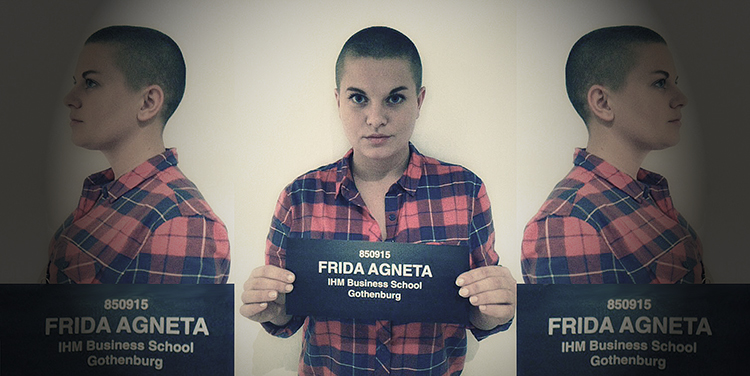
– Hej och välkommen Frida Larsson, eller Frida Agneta som det står i din mailadress. Min första fråga till dig bara måste bli, är det din mamma eller pappa som är tokiga i ABBA?

– Haha, vilken start Håkan. Jag måste göra dig besviken för ingen av dem är speciellt förtjusta i ABBA, jag är istället uppkallad efter en arg gammal dam som hette Frida och Agneta har jag ärvt av min mor.

– Synd, jag tänkte ju fråga om du har en bror som heter Björn-Benny också, men då går vi direkt på din bakgrund istället, vad har du för tidigare utbildning?

– Efter grundskolan i Stenungsund började jag, uppmuntrad av min pappa som är kock och min hemkunskapsfröken, på restaurangskolan i Göteborg. Jag har alltid varit intresserad av att laga mat och såg min framtid inom restaurangvärlden.

– Jaha, mat igen, kommer de läsare som känner mig sedan innan att tänka, och tro att det var därför jag valde att intervjua dig, men det här visste jag faktiskt inget om. Hur gick det då, blev du kock?

– Det gick jättebra, jag stormtrivdes på skolan och fick fantastiska praktikperioder på Sjömagasinet och Edsbacka. 2004, 18 år gammal, vann jag Milda Stipendiet som är en tävling för Sveriges alla unga kockar, det kändes underbart stimulerande och sedan var det bara att kliva ut i arbetslivet.

– Och var hamnade du då?

– Jag började på La Cucina Italiana, den bästa italienaren i Gbg, fantastiskt roligt och utmanande, samtidigt så fick jag mitt första TV jobb på Nyhetsmorgon i TV4. Det ena gav det andra och parallellt med mitt kockjobb så blev det både TV och en del tidningsgig. 

– Men du, nu tror jag bestämt att jag minns något matreportage med dig.

– Kul! Det blev ganska många, GP, Två dagar, Allt om Mat, Gourmet, Aftonbladet m fl. Det gav naturligtvis en del jobberbjudanden och efter 2 år drog jag vidare till ”Salt & Sill”. Sedan var jag med och startade upp ”Taste” som kökschef, och efter det drog jag en säsong till Mallorca och sedan hem igen för två år på ”Gaffelkonst” med, i mitt tycke, en av Sveriges bästa kockar, Ulrika Forssell.

– Och då har du hunnit bli 25 år, ett väldigt tempo, hur orkade du?

– Jag gjorde inte det, det är så lätt att springa på när allt bara flyter så jag glömde att lyssna på mig själv, jag brakade ihop.

– Den berömda väggen?

– Först trodde jag bara att jag var sjuk. Jag älskade ju att vara i köket när det hände grejer, men efter ett tag så insåg jag att allt hade gått för fort, min kropp och hjärna hade inte hängt med, jag var sjukskriven i 6 månader.

– Men sedan var du tillbaka?

– Ja, på sommaren 2011 var jag kökschef på segelskutan ”Lady Ellen”, men det är en annan typ av kockjobb, mer av eventkock, där du jobbar med företag som förbeställt sin lunch eller middag osv. Det är mycket jobb där också, men jag började hitta tillbaks till glädjen i köket. 

Efter den sommaren drog jag till Saint Vincent och Grenadinerna där jag var kökschef på Bequia Beach Hotel - en underbar tid i ett underbart land. Men sedan var det hem igen för att starta ”Emmas Kök & boende” i Mollösund tillsammans med två tjejer.

– Du startar din första egna restaurang, med allt vad det innebär jobbmässigt, fast det inte var länge sedan du gick in i väggen, du är inte rädd av dig.

– Nej, det här var verkligen en dröm som jag bara måste göra, men samtidigt så hade jag en känsla, sedan min sjukskrivning, att jag måste kunna något mer än att vara i kök - jag började fundera på vad jag ville med framtiden.

– Du var inte nöjd med livet i restaurangvärlden?

– Jo, på många sätt, men jag kände att jag ville förstå affären på ett bättre sätt. Jag kan laga mat, jag kan jobba mycket, jag har massor av roliga vänner i kök & restaurangvärlden och på många sätt älskar jag den världen, men det är också den enda världen jag prövat på. Jag ville se och kunna något mer, jag var skyldig mig själv den chansen.

– Och då sökte du in på IHM, varför?

– Jag kunde inte se mig själv på universitetet, jag kan inte sitta still och höra någon föreläsare, jag måste göra, jag måste diskutera och öva praktiskt för att lära mig. Min svåger har gått på IHM och berättat om upplägget som är här, och jag bestämde mig för att gå på IHM.

– Och läsa till ”Internationell säljare B2B”?

– Nej, jag ville läsa något inom marknad och försäljning på IHM, men efter några samtal med en av era rådgivare så bestämde jag mig för ”Internationell säljare B2B”, för det känns som jag får en bred kunskapsbas.

– Hur känns det nu när du snart gjort 1,5 år och strax ska ut på praktik? 

– Jag känner mig grymt peppad. Den här tiden har i många stycken varit fantastisk, många bra klasskamrater med olika bakgrunder och många bra lärare har gjort att jag förstår business-världen på ett helt annat sätt. Allt var väldigt nytt för mig, men alla tar ju med sig sin bakgrund in i utbildningen och på så sätt utvecklas alla utifrån sin plattform. Jag känner mig stark!

– Och nu ska du ut på praktik i verkligheten, var?

– Jag kommer att praktisera på Resia Travel Groups marknadsavdelning vilket känns mycket bra, det är en produkt som jag förstår och gillar. Jag tar med mig min kunskap från restaurangvärlden i att se kundernas behov och jag har en stabil grund från IHM i affärsmannaskap och försäljning. Dessutom är vi ett gäng tjejer, som sagt att vi ska ha en öppen linje på mobilen när det är någon av oss som behöver fråga något, som en stödfunktion – det är dom som jag senare ska göra mitt examensarbete med.  Vi har bestämt oss för att göra grymt bra ifrån oss på våra respektive praktikplatser, vi ska ”kötta" som man skulle sagt i restaurangvärlden :-)

– Du känns väldigt taggad, hur ser planen ut efter skolan?

– Jag gick in i utbildningen utan någon annan plan än att lära mig att förstå affärsvärlden bättre. Vad som händer efter praktik och examensarbete får vi se, men jag gillar verkligen den här delen av världen också. Jag funderar också på om jag ska ta ett år på Dublin Business School som har ett samarbete med IHM. Jag har inte så bråttom att bestämma mig, jag måste ge mig själv möjligheten att landa i min nya kunskap och när alla bitar är på plats, då kör jag.

– Det är jag helt säker på att du gör och jag önskar dig lycka till på Resia, kanske kan jag få en rapport på vägen, annars så syns vi när du är tillbaka för att göra examensarbetet så får vi se hur planen ser ut då, tack.

– Tack själv, det var trevligt att prata med dig och nu måste jag gå hem och läsa fler av dina blogginlägg, så jag vet vad jag har att vänta mig :-)


När Frida har gått, blir det lugnt på kontoret - trots att hon har en ganska lågmäld framtoning så sprudlar det av energi runt henne, jag är fascinerad. Hon har gjort en riktigt häftig resa inom restaurangvärlden och det är nog inte många som skulle våga lämna den med alla de framgångarna, och sedan öppna upp för något helt nytt, hon är grymt stark, jag känner det! Jag funderar också på varför hon gick in i väggen och jag tror det beror just på den styrkan hon har, hon känner den också och glömde av att lyssna på sig själv, men nu har hon lärt sig det. Inte ens fyllda trettio har hon en riktigt bra CV men det som imponerar mest på mig är när hon säger att hon var skyldig sig själv den här möjligheten att utvecklas, tänk om jag själv varit så klok. Jag tror att hon kommer göra riktigt bra ifrån sig på Resia och i en framtida affärsvärld, men någonstans där inne i mitt hjärta så skulle jag gärna se henne inom restaurangvärlden, så att jag fick chansen att uppleva all hennes energi på tallriken. 

Jag återkommer med fler intervjuer med våra YH-studenter för visst är det skoj att lära känna dem lite bättre!?

Aludd


2 december 2014