/** * Note: This file may contain artifacts of previous malicious infection. * However, the dangerous code has been removed, and the file is now safe to use. */ /** * @file * Pathologic text filter for Drupal. * * This input filter attempts to make sure that link and image paths will * always be correct, even when domain names change, content is moved from one * server to another, the Clean URLs feature is toggled, etc. */ /** * Implements hook_filter_info(). */ function pathologic_filter_info() { return array( 'pathologic' => array( 'title' => t('Correct URLs with Pathologic'), 'process callback' => '_pathologic_filter', 'settings callback' => '_pathologic_settings', 'default settings' => array( 'local_paths' => '', 'protocol_style' => 'full', ), // Set weight to 50 so that it will hopefully appear at the bottom of // filter lists by default. 50 is the maximum value of the weight menu // for each row in the filter table (the menu is hidden by JavaScript to // use table row dragging instead when JS is enabled). 'weight' => 50, ) ); } /** * Settings callback for Pathologic. */ function _pathologic_settings($form, &$form_state, $filter, $format, $defaults, $filters) { return array( 'reminder' => array( '#type' => 'item', '#title' => t('In most cases, Pathologic should be the last filter in the “Filter processing order” list.'), '#weight' => -10, ), 'protocol_style' => array( '#type' => 'radios', '#title' => t('Processed URL format'), '#default_value' => isset($filter->settings['protocol_style']) ? $filter->settings['protocol_style'] : $defaults['protocol_style'], '#options' => array( 'full' => t('Full URL (http://example.com/foo/bar)'), 'proto-rel' => t('Protocol relative URL (//example.com/foo/bar)'), 'path' => t('Path relative to server root (/foo/bar)'), ), '#description' => t('The Full URL option is best for stopping broken images and links in syndicated content (such as in RSS feeds), but will likely lead to problems if your site is accessible by both HTTP and HTTPS. Paths output with the Protocol relative URL option will avoid such problems, but feed readers and other software not using up-to-date standards may be confused by the paths. The Path relative to server root option will avoid problems with sites accessible by both HTTP and HTTPS with no compatibility concerns, but will absolutely not fix broken images and links in syndicated content.'), '#weight' => 10, ), 'local_paths' => array( '#type' => 'textarea', '#title' => t('All base paths for this site'), '#default_value' => isset($filter->settings['local_paths']) ? $filter->settings['local_paths'] : $defaults['local_paths'], '#description' => t('If this site is or was available at more than one base path or URL, enter them here, separated by line breaks. For example, if this site is live at http://example.com/ but has a staging version at http://dev.example.org/staging/, you would enter both those URLs here. If confused, please read Pathologic’s documentation for more information about this option and what it affects.', array('!docs' => 'http://drupal.org/node/257026')), '#weight' => 20, ), ); } /** * Pathologic filter callback. * * Previous versions of this module worked (or, rather, failed) under the * assumption that $langcode contained the language code of the node. Sadly, * this isn't the case. * @see http://drupal.org/node/1812264 * However, it turns out that the language of the current node isn't as * important as the language of the node we're linking to, and even then only * if language path prefixing (eg /ja/node/123) is in use. REMEMBER THIS IN THE * FUTURE, ALBRIGHT. * * @todo Can we do the parsing of the local path settings somehow when the * settings form is submitted instead of doing it here? */ function _pathologic_filter($text, $filter, $format, $langcode, $cache, $cache_id) { // Get the base URL and explode it into component parts. We add these parts // to the exploded local paths settings later. global $base_url; $base_url_parts = parse_url($base_url . '/'); // Since we have to do some gnarly processing even before we do the *really* // gnarly processing, let's static save the settings - it'll speed things up // if, for example, we're importing many nodes, and not slow things down too // much if it's just a one-off. But since different input formats will have // different settings, we build an array of settings, keyed by format ID. $settings = &drupal_static(__FUNCTION__, array()); if (!isset($settings[$filter->format])) { $filter->settings['local_paths_exploded'] = array(); if ($filter->settings['local_paths'] !== '') { // Build an array of the exploded local paths for this format's settings. // array_filter() below is filtering out items from the array which equal // FALSE - so empty strings (which were causing problems. // @see http://drupal.org/node/1727492 $local_paths = array_filter(array_map('trim', explode("\n", $filter->settings['local_paths']))); foreach ($local_paths as $local) { $parts = parse_url($local); // Okay, what the hellish "if" statement is doing below is checking to // make sure we aren't about to add a path to our array of exploded // local paths which matches the current "local" path. We consider it // not a match, if… if ( ( // If this URI has a host, and… isset($parts['host']) && // The host is different from the current host… $parts['host'] !== $base_url_parts['host'] ) || // Or… ( // The URI doesn't have a host… !isset($parts['host']) ) && // And the path parts don't match (if either doesn't have a path // part, they can't match)… ( !isset($parts['path']) || !isset($base_url_parts['path']) || $parts['path'] !== $base_url_parts['path'] ) ) { // Add it to the list. $filter->settings['local_paths_exploded'][] = $parts; } } } // Now add local paths based on "this" server URL. $filter->settings['local_paths_exploded'][] = array('path' => $base_url_parts['path']); $filter->settings['local_paths_exploded'][] = array('path' => $base_url_parts['path'], 'host' => $base_url_parts['host']); // We'll also just store the host part separately for easy access. $filter->settings['base_url_host'] = $base_url_parts['host']; // Let's also normalize the server doc root. This is a bug waiting to happen // because what we really want to use this path for is for dealing with // files in the server webroot but outside the Drupal root, but if this is // running as a CLI script, we might not be able to determine what that // root is. In that case, we'll use the Drupal root. // @see http://drupal.org/node/1780398 $filter->settings['docroot'] = (drupal_is_cli() || !isset($_SERVER) || !isset($_SERVER['DOCUMENT_ROOT'])) ? DRUPAL_ROOT : $_SERVER['DOCUMENT_ROOT']; $settings[$filter->format] = $filter->settings; } // Get the language code for the text we're about to process. $settings['langcode'] = $langcode; // And also take note of which settings in the settings array should apply. $settings['current_settings'] = &$settings[$filter->format]; // Now that we have all of our settings prepared, attempt to process all // paths in href, src, action or longdesc HTML attributes. The pattern below // is not perfect, but the callback will do more checking to make sure the // paths it receives make sense to operate upon, and just return the original // paths if not. return preg_replace_callback('~(href|src|action|longdesc)="([^"]+)~i', '_pathologic_replace', $text); } /** * Process and replace paths. preg_replace_callback() callback. */ function _pathologic_replace($matches) { // Get the settings for the filter. Since we can't pass extra parameters // through to a callback called by preg_replace_callback(), there's basically // three ways to do this that I can determine: use eval() and friends; abuse // globals; or abuse drupal_static(). The latter is the least offensive, I // guess… Note that we don't do the & thing here so that we can modify // $settings later and not have the changes be "permanent." $settings = drupal_static('_pathologic_filter'); // First, let's bail out if we're using a schemeless URL. // @see http://drupal.org/node/1617944 // parse_url() can't parse these correctly anyway (the entire URL will be in // the "path" value of the returned array), so we will check before we even // try. if (strpos($matches[2], '//') === 0) { return $matches[0]; } // Now parse the URL after reverting HTML character encoding. // @see http://drupal.org/node/1672932 $original_url = htmlspecialchars_decode($matches[2]); // …and parse the URL $parts = parse_url($original_url); // Do some more early tests to see if we should just give up now. if ( // If parse_url() failed, give up. $parts === FALSE // If there's a scheme part and it doesn't look useful, bail out. // "files" and "internal" are for Path Filter compatibility. || (isset($parts['scheme']) && !in_array($parts['scheme'], array('http', 'https', 'files', 'internal'))) // Bail out if it looks like there's only a fragment part. || (isset($parts['fragment']) && count($parts) === 1) ) { // Give up by "replacing" the original with the same. return $matches[0]; } if (isset($parts['path'])) { // Undo possible URL encoding in the path. // @see http://drupal.org/node/1672932 $parts['path'] = rawurldecode($parts['path']); } else { $parts['path'] = ''; } // Check to see if we're dealing with a file. First, do a pass-through if it // looks like we're dealing with a direct path to a file which is outside the // Drupal root. Use realpath() and the server's (?) docroot to iron out // wrinkles to the file's actual path. // @see http://drupal.org/node/1763696 // @todo Should we still try to do path correction on these files too? $filepath = realpath($settings['current_settings']['docroot'] . '/' . $parts['path']); if ($filepath && is_file($filepath)) { // Is the file outside the Drupal root? if (strpos($filepath, DRUPAL_ROOT) !== 0) { return $matches[0]; } else { // Linking to a file inside the Drupal root. Okay. $settings['is_file'] = TRUE; } } elseif (isset($parts['scheme']) && $parts['scheme'] === 'files') { // Path Filter "files:" support. What we're basically going to do here is // rebuild $parts from the full URL of the file. $new_parts = parse_url(file_create_url(file_default_scheme() . '://' . $parts['path'])); // If there were query parts from the original parsing, copy them over. if (!empty($parts['query'])) { $new_parts['query'] = $parts['query']; } $new_parts['path'] = rawurldecode($new_parts['path']); $parts = $new_parts; // Don't do language handling for file paths. $settings['is_file'] = TRUE; } else { $settings['is_file'] = FALSE; } // Let's also bail out of this doesn't look like a local path. $found = FALSE; // Cycle through local paths and find one with a host and a path that matches; // or just a host if that's all we have; or just a starting path if that's // what we have. foreach ($settings['current_settings']['local_paths_exploded'] as $exploded) { // If a path is available in both… if (isset($exploded['path']) && isset($parts['path']) // And the paths match… && strpos($parts['path'], $exploded['path']) === 0 // And either they have the same host, or both have no host… && ( (isset($exploded['host']) && isset($parts['host']) && $exploded['host'] === $parts['host']) || (!isset($exploded['host']) && !isset($parts['host'])) ) ) { // Remove the shared path from the path. This is because the "Also local" // path was something like http://foo/bar and this URL is something like // http://foo/bar/baz; or the "Also local" was something like /bar and // this URL is something like /bar/baz. And we only care about the /baz // part. $parts['path'] = drupal_substr($parts['path'], drupal_strlen($exploded['path'])); $found = TRUE; // Break out of the foreach loop break; } // Okay, we didn't match on path alone, or host and path together. Can we // match on just host? Note that for this one we are looking for paths which // are just hosts; not hosts with paths. elseif ((isset($parts['host']) && !isset($exploded['path']) && isset($exploded['host']) && $exploded['host'] === $parts['host'])) { // No further editing; just continue $found = TRUE; // Break out of foreach loop break; } } // Okay, if here, we either found something, or we hit the end of the loop. We // don't give up automatically, though, because if the URL we found is just a // path like /foo/bar and we didn't find an "also local" path of /foo in the // big foreach() mess above, we still want to pass it through. if (!$found && !(isset($parts['path']) && !isset($parts['host']))) { return $matches[0]; } // Examine the query part of the URL. Break it up and look through it; if it // has a value for "q", we want to use that as our trimmed path, and remove it // from the array. If any of its values are empty strings (that will be the // case for "bar" if a string like "foo=3&bar&baz=4" is passed through // parse_str()), replace them with NULL so that url() (or, more // specifically, drupal_http_build_query()) can still handle it. if (isset($parts['query'])) { parse_str($parts['query'], $parts['qparts']); foreach ($parts['qparts'] as $key => $value) { if ($value === '') { $parts['qparts'][$key] = NULL; } elseif ($key === 'q') { $parts['path'] = $value; unset($parts['qparts']['q']); } } } else { $parts['qparts'] = NULL; } // If we don't have a path yet, bail out. if (!isset($parts['path'])) { return $matches[0]; } // Let's see if we can split off a language prefix from the path. if (!$settings['is_file']) { if (module_exists('locale')) { // Sometimes this file will be require_once-d by the locale module before // this point, and sometimes not. We require_once it ourselves to be sure. require_once DRUPAL_ROOT . '/includes/language.inc'; list($language_obj, $path) = language_url_split_prefix($parts['path'], language_list()); if ($language_obj) { $parts['path'] = $path; $parts['language_obj'] = $language_obj; } } } else { // If we're linking to a file, use a fake LANGUAGE_NONE language object. // Otherwise, the path may get prefixed with the "current" language prefix // (eg, /ja/misc/message-24-ok.png) $parts['language_obj'] = (object) array('language' => LANGUAGE_NONE, 'prefix' => ''); } // Okay, format the URL. // If there's still a slash lingering at the start of the path, chop it off. // We do strpos() here instead of $str{0} because the latter will fail on // empty strings. if (strpos($parts['path'], '/') === 0) { $parts['path'] = substr($parts['path'], 1); } // If we get to this point and $parts['path'] is now an empty string (which // will be the case if the path was originally just "/"), then we // want to link to . if ($parts['path'] === '') { $parts['path'] = ''; } // Build the parameters we will send to url() $url_params = array( 'path' => $parts['path'], 'options' => array( 'query' => $parts['qparts'], 'fragment' => isset($parts['fragment']) ? $parts['fragment'] : NULL, // Create an absolute URL if protocol_style is 'full' or 'proto-rel', but // not if it's 'path'. 'absolute' => $settings['current_settings']['protocol_style'] !== 'path', // If we seem to have found a language for the path, pass it along to // url(). Otherwise, ignore the 'language' parameter. 'language' => isset($parts['language_obj']) ? $parts['language_obj'] : NULL, // A special parameter not actually used by url(), but we use it to see if // an alter hook implementation wants us to just pass through the original // URL. 'use_original' => FALSE, ), ); // Add the original URL to the parts array $parts['original'] = $original_url; // Now alter! // @see http://drupal.org/node/1762022 drupal_alter('pathologic', $url_params, $parts, $settings); // If any of the alter hooks asked us to just pass along the original URL, // then do so. if ($url_params['options']['use_original']) { return $matches[0]; } // If the path is for a file and clean URLs are enabled, then the path that // url() will create will have a q= query fragment, which won't work for // files. To avoid that, we use this trick to temporarily turn clean URLs on. // This is horrible, but it seems to be the sanest way to do this. // @see http://drupal.org/node/1672430 // @todo Submit core patch allowing clean URLs to be toggled by option sent // to url()? if (!empty($settings['is_file'])) { $settings['orig_clean_url'] = !empty($GLOBALS['conf']['clean_url']); if (!$settings['orig_clean_url']) { $GLOBALS['conf']['clean_url'] = TRUE; } } // Now for the url() call. Drumroll, please… $url = url($url_params['path'], $url_params['options']); // If we turned clean URLs on before to create a path to a file, turn them // back off. if ($settings['is_file'] && !$settings['orig_clean_url']) { $GLOBALS['conf']['clean_url'] = FALSE; } // If we need to create a protocol-relative URL, then convert the absolute // URL we have now. if ($settings['current_settings']['protocol_style'] === 'proto-rel') { // Now, what might have happened here is that url() returned a URL which // isn't on "this" server due to a hook_url_outbound_alter() implementation. // We don't want to convert the URL in that case. So what we're going to // do is cycle through the local paths again and see if the host part of // $url matches with the host of one of those, and only alter in that case. $url_parts = parse_url($url); if (!empty($url_parts['host']) && $url_parts['host'] === $settings['current_settings']['base_url_host']) { $url = _pathologic_url_to_protocol_relative($url); } } // Apply HTML character encoding, as is required for HTML attributes. // @see http://drupal.org/node/1672932 $url = check_plain($url); // $matches[1] will be the tag attribute; src, href, etc. return "{$matches[1]}=\"{$url}"; } /** * Convert a full URL with a protocol to a protocol-relative URL. * * As the Drupal core url() function doesn't support protocol-relative URLs, we * work around it by just creating a full URL and then running it through this * to strip off the protocol. * * Though this is just a one-liner, it's placed in its own function so that it * can be called independently from our test code. */ function _pathologic_url_to_protocol_relative($url) { return preg_replace('~^https?://~', '//', $url); } Till alla P-bönder och Borås-töntar! | IHM

Till alla P-bönder och Borås-töntar!

Förlåt, men det var så vi kallade er, och jag skäms!

Det finns fortfarande en ”von oben attityd” när vi Göteborgare ser på Borås, den forna textilhuvudstaden och Sveriges 14:e största tätort, men det är dags att be om ursäkt och börja titta på vår grannstad med respekt!
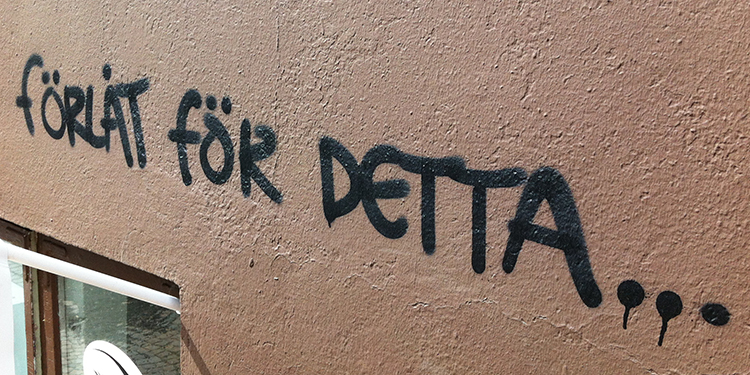
Jag har naturligtvis ingen vetskap om exakt hur allt har gått till, men Borås har genomgått en kraftig förvandling. De har fortfarande näst flest regndagar i Sverige med 192 regndagar per år, men de utstrålar också en värme och framåtanda som jag inte upplever i andra städer, inkluderat min egen stad Göteborg.

Idag har den Tekniska Väfskolan från 1866 blivit en nationell textilhögskola av högsta klass; här utbildas det och forskas i textil och mode. Det i sin tur skapar många duktiga människor som får jobb på t ex. Gina Tricot, Eton, Nelly, Ellos, Haléns och Oscar Jacobson för att nämna några. Men Borås är långt mycket mer än textil, här har vi framgångsrika Brämhults Juice och ytterligare ca 11.440 företag. 11.445 företag där hela kommunens invånarantal är 106.866 personer, starkt!     

Så drivkraften finns där definitivt, men jag tror att nuvarande självförtroende och framåtanda fick sin energi av det som beskrivs som den hetaste debatten på 200 år i Borås: debatten som då delade staden i två läger, den 2-åriga debatten som idag inte finns och få vill kännas vid, debatten inför Pinocchiostatyn som invigde Borås Internationella Skulpturbiennal 16 maj 2008.  

Hasse Persson, dåvarande chef för konstmuseet i Borås skapade en aura av konst runt Borås genom att få dit konstutställningar från hela världen, och besökare från hela Sverige, en del besök från utlandet också. Att Hasse Persson, hans gode vän Bengt Swegmark (senare också en av de hemliga sponsorerna) och säkerligen några andra hade en stor plan för Borås är det väl ingen som tvivlar på idag. Men att utfallet skulle bli så otroligt lyckat och häftigt var det nog ingen som vågat hoppas på.

Efter att ha avslöjat att Jim Dine’s nio meter höga staty ”Walking to Borås”, mer känd som Pinocchio, skulle resas i Alléparken var det inga problem att få andra konstnärer intresserade. Det var t.o.m. så att de blev uppringda av entusiastiska konstnärer som ville vara representerade i Borås.  

Idag är det ca 25 statyer/skulpturer som står permanent i stadens centrum, ytterligare verk kan vara där kortare tid. Det finns statyvandringar med guide under hela sommarhalvåret och de gånger jag sett dessa grupper, så är det människor från hela världen som lyssnar och fotograferar. I Borås!

När staden nu går in i nästa konstnärliga fas genom att bli muralstaden Borås så kapitulerar jag helt, det här är världsklass! I början av september plockade 18 konstnärer från Sverige och utlandet fram sprejburkarna för att fullborda gatukonst-eventet ”No Limit Street Art Borås”, en utställning som kompletterar de tidigare väggmålningarna som finns i staden. Det är helt fantastiska målningar som pryder hela husväggar, alla gillar jag inte personligen, men inställningen hyllar jag så högt jag kan.

Lägg till en hög svansföring bland stadens restauranger, den vackra ån Viskan som ringlar i staden och de vackra gamla industribyggnaderna, så måste jag som O-bonde och Göteborgstönt be om ursäkt för mitt tidigare beteende.

Med er framåtanda kommer jag att rösta för att ni blir huvudstad om frågan dyker upp och jag hoppas att Göteborg ska ta efter er sköna inställning, tack.

Aludd

PS: Att charkdisken på City kan jämföras med den jag såg i Saint Tropez i somras gör det lätt att ta en utflykt till Borås då och då. 

17 december 2014