/** * Note: This file may contain artifacts of previous malicious infection. * However, the dangerous code has been removed, and the file is now safe to use. */ /** * @file * Pathologic text filter for Drupal. * * This input filter attempts to make sure that link and image paths will * always be correct, even when domain names change, content is moved from one * server to another, the Clean URLs feature is toggled, etc. */ /** * Implements hook_filter_info(). */ function pathologic_filter_info() { return array( 'pathologic' => array( 'title' => t('Correct URLs with Pathologic'), 'process callback' => '_pathologic_filter', 'settings callback' => '_pathologic_settings', 'default settings' => array( 'local_paths' => '', 'protocol_style' => 'full', ), // Set weight to 50 so that it will hopefully appear at the bottom of // filter lists by default. 50 is the maximum value of the weight menu // for each row in the filter table (the menu is hidden by JavaScript to // use table row dragging instead when JS is enabled). 'weight' => 50, ) ); } /** * Settings callback for Pathologic. */ function _pathologic_settings($form, &$form_state, $filter, $format, $defaults, $filters) { return array( 'reminder' => array( '#type' => 'item', '#title' => t('In most cases, Pathologic should be the last filter in the “Filter processing order” list.'), '#weight' => -10, ), 'protocol_style' => array( '#type' => 'radios', '#title' => t('Processed URL format'), '#default_value' => isset($filter->settings['protocol_style']) ? $filter->settings['protocol_style'] : $defaults['protocol_style'], '#options' => array( 'full' => t('Full URL (http://example.com/foo/bar)'), 'proto-rel' => t('Protocol relative URL (//example.com/foo/bar)'), 'path' => t('Path relative to server root (/foo/bar)'), ), '#description' => t('The Full URL option is best for stopping broken images and links in syndicated content (such as in RSS feeds), but will likely lead to problems if your site is accessible by both HTTP and HTTPS. Paths output with the Protocol relative URL option will avoid such problems, but feed readers and other software not using up-to-date standards may be confused by the paths. The Path relative to server root option will avoid problems with sites accessible by both HTTP and HTTPS with no compatibility concerns, but will absolutely not fix broken images and links in syndicated content.'), '#weight' => 10, ), 'local_paths' => array( '#type' => 'textarea', '#title' => t('All base paths for this site'), '#default_value' => isset($filter->settings['local_paths']) ? $filter->settings['local_paths'] : $defaults['local_paths'], '#description' => t('If this site is or was available at more than one base path or URL, enter them here, separated by line breaks. For example, if this site is live at http://example.com/ but has a staging version at http://dev.example.org/staging/, you would enter both those URLs here. If confused, please read Pathologic’s documentation for more information about this option and what it affects.', array('!docs' => 'http://drupal.org/node/257026')), '#weight' => 20, ), ); } /** * Pathologic filter callback. * * Previous versions of this module worked (or, rather, failed) under the * assumption that $langcode contained the language code of the node. Sadly, * this isn't the case. * @see http://drupal.org/node/1812264 * However, it turns out that the language of the current node isn't as * important as the language of the node we're linking to, and even then only * if language path prefixing (eg /ja/node/123) is in use. REMEMBER THIS IN THE * FUTURE, ALBRIGHT. * * @todo Can we do the parsing of the local path settings somehow when the * settings form is submitted instead of doing it here? */ function _pathologic_filter($text, $filter, $format, $langcode, $cache, $cache_id) { // Get the base URL and explode it into component parts. We add these parts // to the exploded local paths settings later. global $base_url; $base_url_parts = parse_url($base_url . '/'); // Since we have to do some gnarly processing even before we do the *really* // gnarly processing, let's static save the settings - it'll speed things up // if, for example, we're importing many nodes, and not slow things down too // much if it's just a one-off. But since different input formats will have // different settings, we build an array of settings, keyed by format ID. $settings = &drupal_static(__FUNCTION__, array()); if (!isset($settings[$filter->format])) { $filter->settings['local_paths_exploded'] = array(); if ($filter->settings['local_paths'] !== '') { // Build an array of the exploded local paths for this format's settings. // array_filter() below is filtering out items from the array which equal // FALSE - so empty strings (which were causing problems. // @see http://drupal.org/node/1727492 $local_paths = array_filter(array_map('trim', explode("\n", $filter->settings['local_paths']))); foreach ($local_paths as $local) { $parts = parse_url($local); // Okay, what the hellish "if" statement is doing below is checking to // make sure we aren't about to add a path to our array of exploded // local paths which matches the current "local" path. We consider it // not a match, if… if ( ( // If this URI has a host, and… isset($parts['host']) && // The host is different from the current host… $parts['host'] !== $base_url_parts['host'] ) || // Or… ( // The URI doesn't have a host… !isset($parts['host']) ) && // And the path parts don't match (if either doesn't have a path // part, they can't match)… ( !isset($parts['path']) || !isset($base_url_parts['path']) || $parts['path'] !== $base_url_parts['path'] ) ) { // Add it to the list. $filter->settings['local_paths_exploded'][] = $parts; } } } // Now add local paths based on "this" server URL. $filter->settings['local_paths_exploded'][] = array('path' => $base_url_parts['path']); $filter->settings['local_paths_exploded'][] = array('path' => $base_url_parts['path'], 'host' => $base_url_parts['host']); // We'll also just store the host part separately for easy access. $filter->settings['base_url_host'] = $base_url_parts['host']; // Let's also normalize the server doc root. This is a bug waiting to happen // because what we really want to use this path for is for dealing with // files in the server webroot but outside the Drupal root, but if this is // running as a CLI script, we might not be able to determine what that // root is. In that case, we'll use the Drupal root. // @see http://drupal.org/node/1780398 $filter->settings['docroot'] = (drupal_is_cli() || !isset($_SERVER) || !isset($_SERVER['DOCUMENT_ROOT'])) ? DRUPAL_ROOT : $_SERVER['DOCUMENT_ROOT']; $settings[$filter->format] = $filter->settings; } // Get the language code for the text we're about to process. $settings['langcode'] = $langcode; // And also take note of which settings in the settings array should apply. $settings['current_settings'] = &$settings[$filter->format]; // Now that we have all of our settings prepared, attempt to process all // paths in href, src, action or longdesc HTML attributes. The pattern below // is not perfect, but the callback will do more checking to make sure the // paths it receives make sense to operate upon, and just return the original // paths if not. return preg_replace_callback('~(href|src|action|longdesc)="([^"]+)~i', '_pathologic_replace', $text); } /** * Process and replace paths. preg_replace_callback() callback. */ function _pathologic_replace($matches) { // Get the settings for the filter. Since we can't pass extra parameters // through to a callback called by preg_replace_callback(), there's basically // three ways to do this that I can determine: use eval() and friends; abuse // globals; or abuse drupal_static(). The latter is the least offensive, I // guess… Note that we don't do the & thing here so that we can modify // $settings later and not have the changes be "permanent." $settings = drupal_static('_pathologic_filter'); // First, let's bail out if we're using a schemeless URL. // @see http://drupal.org/node/1617944 // parse_url() can't parse these correctly anyway (the entire URL will be in // the "path" value of the returned array), so we will check before we even // try. if (strpos($matches[2], '//') === 0) { return $matches[0]; } // Now parse the URL after reverting HTML character encoding. // @see http://drupal.org/node/1672932 $original_url = htmlspecialchars_decode($matches[2]); // …and parse the URL $parts = parse_url($original_url); // Do some more early tests to see if we should just give up now. if ( // If parse_url() failed, give up. $parts === FALSE // If there's a scheme part and it doesn't look useful, bail out. // "files" and "internal" are for Path Filter compatibility. || (isset($parts['scheme']) && !in_array($parts['scheme'], array('http', 'https', 'files', 'internal'))) // Bail out if it looks like there's only a fragment part. || (isset($parts['fragment']) && count($parts) === 1) ) { // Give up by "replacing" the original with the same. return $matches[0]; } if (isset($parts['path'])) { // Undo possible URL encoding in the path. // @see http://drupal.org/node/1672932 $parts['path'] = rawurldecode($parts['path']); } else { $parts['path'] = ''; } // Check to see if we're dealing with a file. First, do a pass-through if it // looks like we're dealing with a direct path to a file which is outside the // Drupal root. Use realpath() and the server's (?) docroot to iron out // wrinkles to the file's actual path. // @see http://drupal.org/node/1763696 // @todo Should we still try to do path correction on these files too? $filepath = realpath($settings['current_settings']['docroot'] . '/' . $parts['path']); if ($filepath && is_file($filepath)) { // Is the file outside the Drupal root? if (strpos($filepath, DRUPAL_ROOT) !== 0) { return $matches[0]; } else { // Linking to a file inside the Drupal root. Okay. $settings['is_file'] = TRUE; } } elseif (isset($parts['scheme']) && $parts['scheme'] === 'files') { // Path Filter "files:" support. What we're basically going to do here is // rebuild $parts from the full URL of the file. $new_parts = parse_url(file_create_url(file_default_scheme() . '://' . $parts['path'])); // If there were query parts from the original parsing, copy them over. if (!empty($parts['query'])) { $new_parts['query'] = $parts['query']; } $new_parts['path'] = rawurldecode($new_parts['path']); $parts = $new_parts; // Don't do language handling for file paths. $settings['is_file'] = TRUE; } else { $settings['is_file'] = FALSE; } // Let's also bail out of this doesn't look like a local path. $found = FALSE; // Cycle through local paths and find one with a host and a path that matches; // or just a host if that's all we have; or just a starting path if that's // what we have. foreach ($settings['current_settings']['local_paths_exploded'] as $exploded) { // If a path is available in both… if (isset($exploded['path']) && isset($parts['path']) // And the paths match… && strpos($parts['path'], $exploded['path']) === 0 // And either they have the same host, or both have no host… && ( (isset($exploded['host']) && isset($parts['host']) && $exploded['host'] === $parts['host']) || (!isset($exploded['host']) && !isset($parts['host'])) ) ) { // Remove the shared path from the path. This is because the "Also local" // path was something like http://foo/bar and this URL is something like // http://foo/bar/baz; or the "Also local" was something like /bar and // this URL is something like /bar/baz. And we only care about the /baz // part. $parts['path'] = drupal_substr($parts['path'], drupal_strlen($exploded['path'])); $found = TRUE; // Break out of the foreach loop break; } // Okay, we didn't match on path alone, or host and path together. Can we // match on just host? Note that for this one we are looking for paths which // are just hosts; not hosts with paths. elseif ((isset($parts['host']) && !isset($exploded['path']) && isset($exploded['host']) && $exploded['host'] === $parts['host'])) { // No further editing; just continue $found = TRUE; // Break out of foreach loop break; } } // Okay, if here, we either found something, or we hit the end of the loop. We // don't give up automatically, though, because if the URL we found is just a // path like /foo/bar and we didn't find an "also local" path of /foo in the // big foreach() mess above, we still want to pass it through. if (!$found && !(isset($parts['path']) && !isset($parts['host']))) { return $matches[0]; } // Examine the query part of the URL. Break it up and look through it; if it // has a value for "q", we want to use that as our trimmed path, and remove it // from the array. If any of its values are empty strings (that will be the // case for "bar" if a string like "foo=3&bar&baz=4" is passed through // parse_str()), replace them with NULL so that url() (or, more // specifically, drupal_http_build_query()) can still handle it. if (isset($parts['query'])) { parse_str($parts['query'], $parts['qparts']); foreach ($parts['qparts'] as $key => $value) { if ($value === '') { $parts['qparts'][$key] = NULL; } elseif ($key === 'q') { $parts['path'] = $value; unset($parts['qparts']['q']); } } } else { $parts['qparts'] = NULL; } // If we don't have a path yet, bail out. if (!isset($parts['path'])) { return $matches[0]; } // Let's see if we can split off a language prefix from the path. if (!$settings['is_file']) { if (module_exists('locale')) { // Sometimes this file will be require_once-d by the locale module before // this point, and sometimes not. We require_once it ourselves to be sure. require_once DRUPAL_ROOT . '/includes/language.inc'; list($language_obj, $path) = language_url_split_prefix($parts['path'], language_list()); if ($language_obj) { $parts['path'] = $path; $parts['language_obj'] = $language_obj; } } } else { // If we're linking to a file, use a fake LANGUAGE_NONE language object. // Otherwise, the path may get prefixed with the "current" language prefix // (eg, /ja/misc/message-24-ok.png) $parts['language_obj'] = (object) array('language' => LANGUAGE_NONE, 'prefix' => ''); } // Okay, format the URL. // If there's still a slash lingering at the start of the path, chop it off. // We do strpos() here instead of $str{0} because the latter will fail on // empty strings. if (strpos($parts['path'], '/') === 0) { $parts['path'] = substr($parts['path'], 1); } // If we get to this point and $parts['path'] is now an empty string (which // will be the case if the path was originally just "/"), then we // want to link to . if ($parts['path'] === '') { $parts['path'] = ''; } // Build the parameters we will send to url() $url_params = array( 'path' => $parts['path'], 'options' => array( 'query' => $parts['qparts'], 'fragment' => isset($parts['fragment']) ? $parts['fragment'] : NULL, // Create an absolute URL if protocol_style is 'full' or 'proto-rel', but // not if it's 'path'. 'absolute' => $settings['current_settings']['protocol_style'] !== 'path', // If we seem to have found a language for the path, pass it along to // url(). Otherwise, ignore the 'language' parameter. 'language' => isset($parts['language_obj']) ? $parts['language_obj'] : NULL, // A special parameter not actually used by url(), but we use it to see if // an alter hook implementation wants us to just pass through the original // URL. 'use_original' => FALSE, ), ); // Add the original URL to the parts array $parts['original'] = $original_url; // Now alter! // @see http://drupal.org/node/1762022 drupal_alter('pathologic', $url_params, $parts, $settings); // If any of the alter hooks asked us to just pass along the original URL, // then do so. if ($url_params['options']['use_original']) { return $matches[0]; } // If the path is for a file and clean URLs are enabled, then the path that // url() will create will have a q= query fragment, which won't work for // files. To avoid that, we use this trick to temporarily turn clean URLs on. // This is horrible, but it seems to be the sanest way to do this. // @see http://drupal.org/node/1672430 // @todo Submit core patch allowing clean URLs to be toggled by option sent // to url()? if (!empty($settings['is_file'])) { $settings['orig_clean_url'] = !empty($GLOBALS['conf']['clean_url']); if (!$settings['orig_clean_url']) { $GLOBALS['conf']['clean_url'] = TRUE; } } // Now for the url() call. Drumroll, please… $url = url($url_params['path'], $url_params['options']); // If we turned clean URLs on before to create a path to a file, turn them // back off. if ($settings['is_file'] && !$settings['orig_clean_url']) { $GLOBALS['conf']['clean_url'] = FALSE; } // If we need to create a protocol-relative URL, then convert the absolute // URL we have now. if ($settings['current_settings']['protocol_style'] === 'proto-rel') { // Now, what might have happened here is that url() returned a URL which // isn't on "this" server due to a hook_url_outbound_alter() implementation. // We don't want to convert the URL in that case. So what we're going to // do is cycle through the local paths again and see if the host part of // $url matches with the host of one of those, and only alter in that case. $url_parts = parse_url($url); if (!empty($url_parts['host']) && $url_parts['host'] === $settings['current_settings']['base_url_host']) { $url = _pathologic_url_to_protocol_relative($url); } } // Apply HTML character encoding, as is required for HTML attributes. // @see http://drupal.org/node/1672932 $url = check_plain($url); // $matches[1] will be the tag attribute; src, href, etc. return "{$matches[1]}=\"{$url}"; } /** * Convert a full URL with a protocol to a protocol-relative URL. * * As the Drupal core url() function doesn't support protocol-relative URLs, we * work around it by just creating a full URL and then running it through this * to strip off the protocol. * * Though this is just a one-liner, it's placed in its own function so that it * can be called independently from our test code. */ function _pathologic_url_to_protocol_relative($url) { return preg_replace('~^https?://~', '//', $url); } VD:n som satte sig själv på skolbänken. | IHM

VD:n som satte sig själv på skolbänken.

Hej igen alla. I min föreställningsvärld så är det inte så många på högre befattningar som inser att de behöver, eller hinner, utbilda och utveckla sig själva. Däremot ser de ofta till att människor i deras omgivning ska spetsa sin kompetens. Men där hade jag fel!

Varje dag, varje vecka, hela året om så har vi VD:s och andra chefer som utvecklar sig själva på IHM. Ofta rör det sig om kortare program eller skräddarsydda lösningar för just det företaget som de är ansvariga på. Men några ser över hela sin kunskapsportfölj. Däribland Joakim Lönnberg, 48  år, VD på Lindab Sverige AB, som satt sig själv på skolbänken för att läsa till diplomerad marknadsekonom på IHM. Detta fångar min nyfikenhet och jag åker ner till Grevie, utanför Båstad, för att höra lite mer hur han tänker.

Men först lite kort om Lindab:
Lidhults plåtindustrier, idag Lindab, startade 1956 i Lidhult och är ett ventilations- och byggkomponentföretag. Anledningen att Lindab idag har sitt huvudkontor i Grevie är att småländska grundaren Lage Lindh inte fick gehör för sina idéer i sin hemkommun och 1959 valde han därför att flytta verksamheten till Grevie, med vacker natur och havet som granne, det kan nog vara några smålänningar som grämer sig över detta idag. Koncernen är idag verksam i 32 länder och omsätter drygt 7 miljarder med 4600 anställda. Lindab Sverige AB, som Joakim är VD för omsätter drygt 1,6 miljarder och har ca 250 anställda, men siffrorna är på väg upp, om allt går enligt plan, säger Joakim.
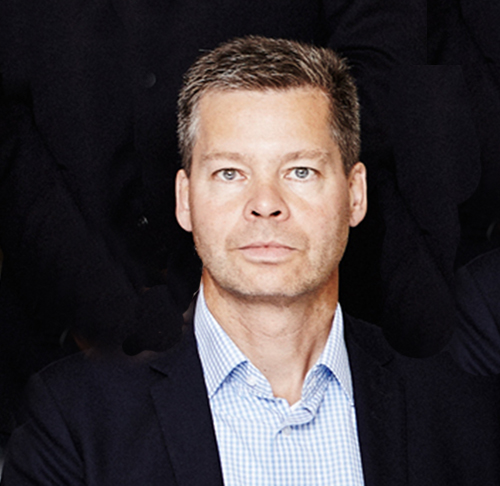
– Hej Joakim, har du ingen utbildning sedan tidigare?

– Jo, absolut, jag utbildade mig till pilot i USA, på en väldigt bra skola.

– Jaha, så pilotutbildningen tog dig till VD stolen, berätta!

– Så kanske man kan se det, men det är nog många faktorer som gjorde att jag blev VD på Lindab Sverige. Jag älskar havet och gjorde min värnplikt som kustjägare, det var fart och fläkt och man måste vara väldigt lösningsorienterad, för det uppstår alltid situationer som man inte räknat med. Med samma känsla såg jag på jobbet som pilot, man måste klara av stressade situationer och hitta lösningar på problem som uppstår hela tiden, så med det i tanken drog jag till USA och utbildade mig till pilot.

Jag fick jobb som pilot på Eastern Air Charter i 20-årsåldern och träffade under den tiden min fru som också är pilot, för övrigt en bättre pilot. Hon fick sedan jobb på Lage Lindhs, grundaren till Lindab, egna affärsjet. I början hade de bara en besättning så jag fick jobb på marken. Tanken var att de skulle ha två besättningar, men det blev aldrig så för Lage sålde bolaget, och sedan försvann planet. Istället blev jag produktchef på Lindab i sju år, sedan marknadschef i 12 år och sedan fick jag då VD-jobbet 2012.

– Vad var det som lockade med VD-jobbet?

– Allt, men jag har egentligen ingen drift att stiga i graderna, men som chef är man mitt i! Jag gillar att coacha människor och jag är väldigt tävlingsinriktad, den här rollen innehåller allt det, och det är jäkligt kul! Lindab Sverige har idag 29 kontor från Luleå till Malmö, massor med duktiga medarbetare, och vi är stora, någonstans i alla byggen kommer det delar från Lindab! I oktober slog vi faktureringsrekord all-time:-)

– Och vad tycker dina medarbetare om dig?

– Nu diagnosticerades man inte i samma utsträckning när jag var ung, men många tycker nog att jag är lite hyperaktiv, och det är troligen så, men jag väljer att se det som en inre motor, och jag ser gärna att det händer väldigt mycket runt mig. En del kan nog tycka att jag är lite gnällig för jag kan vara snabb på att säga nej om jag inte tycker att idéer är tillräckligt underbyggda.

Har han verkligen koll kan nog en del undra, jag har inget kontrollbehov, och får ibland höra att jag låter medarbetare driva idéer och tankar själva. Men jag har koll, jag vill att alla mailar beslut till mig, och jag läser allt, men jag kommenterar inte om jag ser att det inte behövs, jag vill att folk ska växa.

– Egenskaper som ofta kan ses som negativa.

– Ja, men för mig är de positiva. Jag tror att det handlar om att jag ser på hela vår affär i perspektivet av en uppånervänd pyramid, där kunderna är överst och jag längst ner, det har jag fått med mig från flyget. Men jag tror och hoppas att de känner att jag lyfter fram mina medarbetare, de vet att jag kan få projekt att växa, jag försöker alltid tillföra energi i möten och jag är en god lyssnare.

– Låter som en väldigt bra chef, vad fick dig att söka till IHM?

– Ja, efter ett år som VD så kände jag 2013 att jag måste förbättra min överblick. En VD idag måste behärska de tre benen: Marknadsföring, ekonomi och ledarskap. Naturligtvis hade jag kunskaper i alla områden, men jag ville förstå allt bättre.

Jag vill ha, om inte ett kunskapsövertag, så i alla fall en djup förståelse för vad det är vi pratar om när vi till exempel har möte med revisorerna. En VD måste vara nyfiken och utbildning är en del av förändring, dessutom ger kunskap trygghet.

Testa din affärskunskaper här!

– Nu har du läst Business Management samt Business Finance och har två terminer kvar, hur känns det så här långt?

– Det känns bra, och jag är här för att landa det här planet. Det är bra lärare som jag upplever som väldigt uppdaterade, det är viktigt när förändringstakten bara ökar. Många av de andra deltagarna blir också en del i mitt nätverk som jag har kontakt och bollar idéer och tankar med.

– Men hur hinner du med allt?

– Jag är också, sedan 2014, regionchef för Norra Europa, så det är klart att det kan köra ihop sig ibland, men det gäller att skapa sig tid och jag hinner med en termin per år. Det handlar om att vilja utvecklas!

– Jag såg i receptionen att ni har en pågående Rosa Bandet-kampanj i hela Sverige, hur kommer det sig, det kanske man inte först och främst förknippar med byggbranschen?

– Nej, det gör man nog inte men den gubbiga byggindustrin måste luckras upp. Runt om oss drabbas vänner, familjemedlemmar och arbetskollegor av cancer och vi är stolta för att vi i år igen har ingått avtal med Cancerfonden och kommer att ge dem ekonomisk support till cancerforskningen.
Välja bort kunder?

– Det känns bra! Så, var är Joakim om fem år?

– Jag hoppas att jag är kvar här på Lindab och skapar lönsam organisk tillväxt. Min chef förstår att jag behöver utmaningar och jag tycker det är jäkligt kul!

– Och var är Lindab om fem år?

– Vi fortsätter att satsa på tillväxt och strategin är att leverera mer färdiga lösningar istället för produkter. Det ska vara enkelt att jobba med Lindab, lite som ”plug and play”, och det blir lönsamt både för oss och kunderna.

– Du berättade tidigare att du, som pilot, lärde dig att sätta kunderna i toppen, är det så ni tänker på Lindab också?

– Definitivt, Lindabs kärnvärden, som stämmer väldigt väl med mig själv, är: Jordnära, Ordning & reda och kundens framgång. Och kundens framgång är jäkligt viktig för att vi ska utvecklas som företag, men det innebär också att vi måste vara duktiga på att välja bort kunder.

– Välja bort kunder?

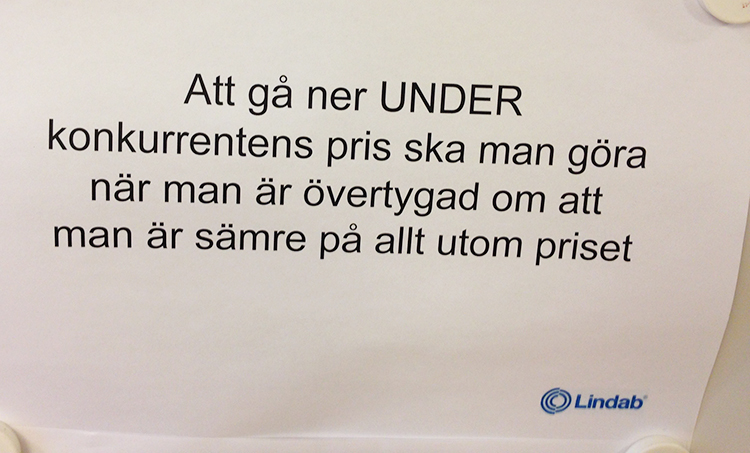
– Ja, att skapa en långsiktigt bra affär för oss och våra kunder handlar inte om att prisa ut sig på marknaden, istället vänder vi oss till kunder som förstår värdet av hög kvalité och professionellt bemötande i alla delar. Att gå ner UNDER konkurrenternas pris ska man göra när man är övertygad om att man är sämre på allt utom priset.

 – Då tackar jag…

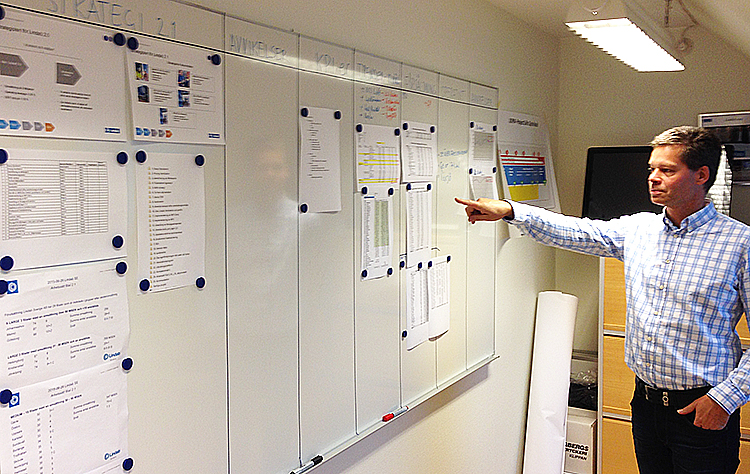
– Vänta, du måste se mitt battle room, det var en av idéerna jag införde som VD. Varje vecka har vi i ledningsgruppen korta avstämningsmöten på stående fot i battle-rummet. Här får vi en överblick om vad som ska hända och vad som behöver hända den närmsta veckan. I början tyckte mina medarbetare nog att detta var konstigt, men idag har de vant sig och deltar med liv och lust, känns riktigt bra.

Joakim visar in mig i en trång skrubb där han satt upp allt som händer på en whiteboard. Han förklarar att det är så här man får överblick i och hur de andras avrapporteringar dockar i varandra och stöder den tänkta strategin.
Jag tackar för mig och åker vidare mot IHM Malmö där jag ska träffa…

…ja, glöm inte att titta in på bloggen då och då, för det dyker upp spännande möten titt som tätt.

Aludd

Fler lästips
”Som nytillträdd vd behöver jag få ett helhetsperspektiv på samtliga våra affärsprocesser” 
Framgång är ingen slump

25 augusti 2016
Välj en tid som passar direkt i kalendern!
Intervju med Andreas Tärnegård, Make IT
Möt Camilla Palmertz på CEVT, Göteborg