/** * Note: This file may contain artifacts of previous malicious infection. * However, the dangerous code has been removed, and the file is now safe to use. */ /** * @file * Pathologic text filter for Drupal. * * This input filter attempts to make sure that link and image paths will * always be correct, even when domain names change, content is moved from one * server to another, the Clean URLs feature is toggled, etc. */ /** * Implements hook_filter_info(). */ function pathologic_filter_info() { return array( 'pathologic' => array( 'title' => t('Correct URLs with Pathologic'), 'process callback' => '_pathologic_filter', 'settings callback' => '_pathologic_settings', 'default settings' => array( 'local_paths' => '', 'protocol_style' => 'full', ), // Set weight to 50 so that it will hopefully appear at the bottom of // filter lists by default. 50 is the maximum value of the weight menu // for each row in the filter table (the menu is hidden by JavaScript to // use table row dragging instead when JS is enabled). 'weight' => 50, ) ); } /** * Settings callback for Pathologic. */ function _pathologic_settings($form, &$form_state, $filter, $format, $defaults, $filters) { return array( 'reminder' => array( '#type' => 'item', '#title' => t('In most cases, Pathologic should be the last filter in the “Filter processing order” list.'), '#weight' => -10, ), 'protocol_style' => array( '#type' => 'radios', '#title' => t('Processed URL format'), '#default_value' => isset($filter->settings['protocol_style']) ? $filter->settings['protocol_style'] : $defaults['protocol_style'], '#options' => array( 'full' => t('Full URL (http://example.com/foo/bar)'), 'proto-rel' => t('Protocol relative URL (//example.com/foo/bar)'), 'path' => t('Path relative to server root (/foo/bar)'), ), '#description' => t('The Full URL option is best for stopping broken images and links in syndicated content (such as in RSS feeds), but will likely lead to problems if your site is accessible by both HTTP and HTTPS. Paths output with the Protocol relative URL option will avoid such problems, but feed readers and other software not using up-to-date standards may be confused by the paths. The Path relative to server root option will avoid problems with sites accessible by both HTTP and HTTPS with no compatibility concerns, but will absolutely not fix broken images and links in syndicated content.'), '#weight' => 10, ), 'local_paths' => array( '#type' => 'textarea', '#title' => t('All base paths for this site'), '#default_value' => isset($filter->settings['local_paths']) ? $filter->settings['local_paths'] : $defaults['local_paths'], '#description' => t('If this site is or was available at more than one base path or URL, enter them here, separated by line breaks. For example, if this site is live at http://example.com/ but has a staging version at http://dev.example.org/staging/, you would enter both those URLs here. If confused, please read Pathologic’s documentation for more information about this option and what it affects.', array('!docs' => 'http://drupal.org/node/257026')), '#weight' => 20, ), ); } /** * Pathologic filter callback. * * Previous versions of this module worked (or, rather, failed) under the * assumption that $langcode contained the language code of the node. Sadly, * this isn't the case. * @see http://drupal.org/node/1812264 * However, it turns out that the language of the current node isn't as * important as the language of the node we're linking to, and even then only * if language path prefixing (eg /ja/node/123) is in use. REMEMBER THIS IN THE * FUTURE, ALBRIGHT. * * @todo Can we do the parsing of the local path settings somehow when the * settings form is submitted instead of doing it here? */ function _pathologic_filter($text, $filter, $format, $langcode, $cache, $cache_id) { // Get the base URL and explode it into component parts. We add these parts // to the exploded local paths settings later. global $base_url; $base_url_parts = parse_url($base_url . '/'); // Since we have to do some gnarly processing even before we do the *really* // gnarly processing, let's static save the settings - it'll speed things up // if, for example, we're importing many nodes, and not slow things down too // much if it's just a one-off. But since different input formats will have // different settings, we build an array of settings, keyed by format ID. $settings = &drupal_static(__FUNCTION__, array()); if (!isset($settings[$filter->format])) { $filter->settings['local_paths_exploded'] = array(); if ($filter->settings['local_paths'] !== '') { // Build an array of the exploded local paths for this format's settings. // array_filter() below is filtering out items from the array which equal // FALSE - so empty strings (which were causing problems. // @see http://drupal.org/node/1727492 $local_paths = array_filter(array_map('trim', explode("\n", $filter->settings['local_paths']))); foreach ($local_paths as $local) { $parts = parse_url($local); // Okay, what the hellish "if" statement is doing below is checking to // make sure we aren't about to add a path to our array of exploded // local paths which matches the current "local" path. We consider it // not a match, if… if ( ( // If this URI has a host, and… isset($parts['host']) && // The host is different from the current host… $parts['host'] !== $base_url_parts['host'] ) || // Or… ( // The URI doesn't have a host… !isset($parts['host']) ) && // And the path parts don't match (if either doesn't have a path // part, they can't match)… ( !isset($parts['path']) || !isset($base_url_parts['path']) || $parts['path'] !== $base_url_parts['path'] ) ) { // Add it to the list. $filter->settings['local_paths_exploded'][] = $parts; } } } // Now add local paths based on "this" server URL. $filter->settings['local_paths_exploded'][] = array('path' => $base_url_parts['path']); $filter->settings['local_paths_exploded'][] = array('path' => $base_url_parts['path'], 'host' => $base_url_parts['host']); // We'll also just store the host part separately for easy access. $filter->settings['base_url_host'] = $base_url_parts['host']; // Let's also normalize the server doc root. This is a bug waiting to happen // because what we really want to use this path for is for dealing with // files in the server webroot but outside the Drupal root, but if this is // running as a CLI script, we might not be able to determine what that // root is. In that case, we'll use the Drupal root. // @see http://drupal.org/node/1780398 $filter->settings['docroot'] = (drupal_is_cli() || !isset($_SERVER) || !isset($_SERVER['DOCUMENT_ROOT'])) ? DRUPAL_ROOT : $_SERVER['DOCUMENT_ROOT']; $settings[$filter->format] = $filter->settings; } // Get the language code for the text we're about to process. $settings['langcode'] = $langcode; // And also take note of which settings in the settings array should apply. $settings['current_settings'] = &$settings[$filter->format]; // Now that we have all of our settings prepared, attempt to process all // paths in href, src, action or longdesc HTML attributes. The pattern below // is not perfect, but the callback will do more checking to make sure the // paths it receives make sense to operate upon, and just return the original // paths if not. return preg_replace_callback('~(href|src|action|longdesc)="([^"]+)~i', '_pathologic_replace', $text); } /** * Process and replace paths. preg_replace_callback() callback. */ function _pathologic_replace($matches) { // Get the settings for the filter. Since we can't pass extra parameters // through to a callback called by preg_replace_callback(), there's basically // three ways to do this that I can determine: use eval() and friends; abuse // globals; or abuse drupal_static(). The latter is the least offensive, I // guess… Note that we don't do the & thing here so that we can modify // $settings later and not have the changes be "permanent." $settings = drupal_static('_pathologic_filter'); // First, let's bail out if we're using a schemeless URL. // @see http://drupal.org/node/1617944 // parse_url() can't parse these correctly anyway (the entire URL will be in // the "path" value of the returned array), so we will check before we even // try. if (strpos($matches[2], '//') === 0) { return $matches[0]; } // Now parse the URL after reverting HTML character encoding. // @see http://drupal.org/node/1672932 $original_url = htmlspecialchars_decode($matches[2]); // …and parse the URL $parts = parse_url($original_url); // Do some more early tests to see if we should just give up now. if ( // If parse_url() failed, give up. $parts === FALSE // If there's a scheme part and it doesn't look useful, bail out. // "files" and "internal" are for Path Filter compatibility. || (isset($parts['scheme']) && !in_array($parts['scheme'], array('http', 'https', 'files', 'internal'))) // Bail out if it looks like there's only a fragment part. || (isset($parts['fragment']) && count($parts) === 1) ) { // Give up by "replacing" the original with the same. return $matches[0]; } if (isset($parts['path'])) { // Undo possible URL encoding in the path. // @see http://drupal.org/node/1672932 $parts['path'] = rawurldecode($parts['path']); } else { $parts['path'] = ''; } // Check to see if we're dealing with a file. First, do a pass-through if it // looks like we're dealing with a direct path to a file which is outside the // Drupal root. Use realpath() and the server's (?) docroot to iron out // wrinkles to the file's actual path. // @see http://drupal.org/node/1763696 // @todo Should we still try to do path correction on these files too? $filepath = realpath($settings['current_settings']['docroot'] . '/' . $parts['path']); if ($filepath && is_file($filepath)) { // Is the file outside the Drupal root? if (strpos($filepath, DRUPAL_ROOT) !== 0) { return $matches[0]; } else { // Linking to a file inside the Drupal root. Okay. $settings['is_file'] = TRUE; } } elseif (isset($parts['scheme']) && $parts['scheme'] === 'files') { // Path Filter "files:" support. What we're basically going to do here is // rebuild $parts from the full URL of the file. $new_parts = parse_url(file_create_url(file_default_scheme() . '://' . $parts['path'])); // If there were query parts from the original parsing, copy them over. if (!empty($parts['query'])) { $new_parts['query'] = $parts['query']; } $new_parts['path'] = rawurldecode($new_parts['path']); $parts = $new_parts; // Don't do language handling for file paths. $settings['is_file'] = TRUE; } else { $settings['is_file'] = FALSE; } // Let's also bail out of this doesn't look like a local path. $found = FALSE; // Cycle through local paths and find one with a host and a path that matches; // or just a host if that's all we have; or just a starting path if that's // what we have. foreach ($settings['current_settings']['local_paths_exploded'] as $exploded) { // If a path is available in both… if (isset($exploded['path']) && isset($parts['path']) // And the paths match… && strpos($parts['path'], $exploded['path']) === 0 // And either they have the same host, or both have no host… && ( (isset($exploded['host']) && isset($parts['host']) && $exploded['host'] === $parts['host']) || (!isset($exploded['host']) && !isset($parts['host'])) ) ) { // Remove the shared path from the path. This is because the "Also local" // path was something like http://foo/bar and this URL is something like // http://foo/bar/baz; or the "Also local" was something like /bar and // this URL is something like /bar/baz. And we only care about the /baz // part. $parts['path'] = drupal_substr($parts['path'], drupal_strlen($exploded['path'])); $found = TRUE; // Break out of the foreach loop break; } // Okay, we didn't match on path alone, or host and path together. Can we // match on just host? Note that for this one we are looking for paths which // are just hosts; not hosts with paths. elseif ((isset($parts['host']) && !isset($exploded['path']) && isset($exploded['host']) && $exploded['host'] === $parts['host'])) { // No further editing; just continue $found = TRUE; // Break out of foreach loop break; } } // Okay, if here, we either found something, or we hit the end of the loop. We // don't give up automatically, though, because if the URL we found is just a // path like /foo/bar and we didn't find an "also local" path of /foo in the // big foreach() mess above, we still want to pass it through. if (!$found && !(isset($parts['path']) && !isset($parts['host']))) { return $matches[0]; } // Examine the query part of the URL. Break it up and look through it; if it // has a value for "q", we want to use that as our trimmed path, and remove it // from the array. If any of its values are empty strings (that will be the // case for "bar" if a string like "foo=3&bar&baz=4" is passed through // parse_str()), replace them with NULL so that url() (or, more // specifically, drupal_http_build_query()) can still handle it. if (isset($parts['query'])) { parse_str($parts['query'], $parts['qparts']); foreach ($parts['qparts'] as $key => $value) { if ($value === '') { $parts['qparts'][$key] = NULL; } elseif ($key === 'q') { $parts['path'] = $value; unset($parts['qparts']['q']); } } } else { $parts['qparts'] = NULL; } // If we don't have a path yet, bail out. if (!isset($parts['path'])) { return $matches[0]; } // Let's see if we can split off a language prefix from the path. if (!$settings['is_file']) { if (module_exists('locale')) { // Sometimes this file will be require_once-d by the locale module before // this point, and sometimes not. We require_once it ourselves to be sure. require_once DRUPAL_ROOT . '/includes/language.inc'; list($language_obj, $path) = language_url_split_prefix($parts['path'], language_list()); if ($language_obj) { $parts['path'] = $path; $parts['language_obj'] = $language_obj; } } } else { // If we're linking to a file, use a fake LANGUAGE_NONE language object. // Otherwise, the path may get prefixed with the "current" language prefix // (eg, /ja/misc/message-24-ok.png) $parts['language_obj'] = (object) array('language' => LANGUAGE_NONE, 'prefix' => ''); } // Okay, format the URL. // If there's still a slash lingering at the start of the path, chop it off. // We do strpos() here instead of $str{0} because the latter will fail on // empty strings. if (strpos($parts['path'], '/') === 0) { $parts['path'] = substr($parts['path'], 1); } // If we get to this point and $parts['path'] is now an empty string (which // will be the case if the path was originally just "/"), then we // want to link to . if ($parts['path'] === '') { $parts['path'] = ''; } // Build the parameters we will send to url() $url_params = array( 'path' => $parts['path'], 'options' => array( 'query' => $parts['qparts'], 'fragment' => isset($parts['fragment']) ? $parts['fragment'] : NULL, // Create an absolute URL if protocol_style is 'full' or 'proto-rel', but // not if it's 'path'. 'absolute' => $settings['current_settings']['protocol_style'] !== 'path', // If we seem to have found a language for the path, pass it along to // url(). Otherwise, ignore the 'language' parameter. 'language' => isset($parts['language_obj']) ? $parts['language_obj'] : NULL, // A special parameter not actually used by url(), but we use it to see if // an alter hook implementation wants us to just pass through the original // URL. 'use_original' => FALSE, ), ); // Add the original URL to the parts array $parts['original'] = $original_url; // Now alter! // @see http://drupal.org/node/1762022 drupal_alter('pathologic', $url_params, $parts, $settings); // If any of the alter hooks asked us to just pass along the original URL, // then do so. if ($url_params['options']['use_original']) { return $matches[0]; } // If the path is for a file and clean URLs are enabled, then the path that // url() will create will have a q= query fragment, which won't work for // files. To avoid that, we use this trick to temporarily turn clean URLs on. // This is horrible, but it seems to be the sanest way to do this. // @see http://drupal.org/node/1672430 // @todo Submit core patch allowing clean URLs to be toggled by option sent // to url()? if (!empty($settings['is_file'])) { $settings['orig_clean_url'] = !empty($GLOBALS['conf']['clean_url']); if (!$settings['orig_clean_url']) { $GLOBALS['conf']['clean_url'] = TRUE; } } // Now for the url() call. Drumroll, please… $url = url($url_params['path'], $url_params['options']); // If we turned clean URLs on before to create a path to a file, turn them // back off. if ($settings['is_file'] && !$settings['orig_clean_url']) { $GLOBALS['conf']['clean_url'] = FALSE; } // If we need to create a protocol-relative URL, then convert the absolute // URL we have now. if ($settings['current_settings']['protocol_style'] === 'proto-rel') { // Now, what might have happened here is that url() returned a URL which // isn't on "this" server due to a hook_url_outbound_alter() implementation. // We don't want to convert the URL in that case. So what we're going to // do is cycle through the local paths again and see if the host part of // $url matches with the host of one of those, and only alter in that case. $url_parts = parse_url($url); if (!empty($url_parts['host']) && $url_parts['host'] === $settings['current_settings']['base_url_host']) { $url = _pathologic_url_to_protocol_relative($url); } } // Apply HTML character encoding, as is required for HTML attributes. // @see http://drupal.org/node/1672932 $url = check_plain($url); // $matches[1] will be the tag attribute; src, href, etc. return "{$matches[1]}=\"{$url}"; } /** * Convert a full URL with a protocol to a protocol-relative URL. * * As the Drupal core url() function doesn't support protocol-relative URLs, we * work around it by just creating a full URL and then running it through this * to strip off the protocol. * * Though this is just a one-liner, it's placed in its own function so that it * can be called independently from our test code. */ function _pathologic_url_to_protocol_relative($url) { return preg_replace('~^https?://~', '//', $url); } George Smidelik, en mästare på upplevelsebaserad inlärning | IHM

George Smidelik, en mästare på upplevelsebaserad inlärning

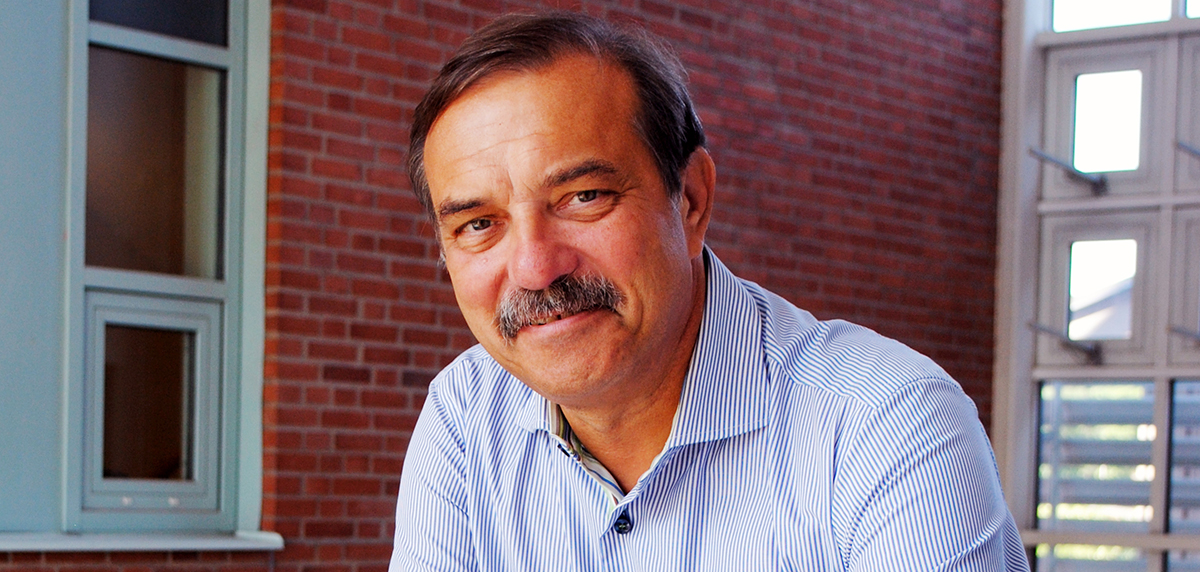
Trots samarbetet med jättar som Ikea och Samsung har George Smideliks företag A&O Konsult en mycket anspråkslös webbplats, som andas sent 90-tal (mer om detta sist i intervjun). Men det är också det enda som slår mig som omodernt med denne man. Hans tankar om hur traditionell utbildning bör förändras är både revolutionerande och inspirerande! Det är inte bara jag som inspireras av stjärnpedagogen från Budapest - så här sa Hönö-krögaren och IHM-alumnen Peder Pedersen under en intervju jag gjorde med honom i förra veckan:

– Ska jag vara helt ärlig så överträffar George allt annat, han är överlägsen alla andra jag haft. Han har en röd tråd i allt han gör. Hade all utbildning i det här landet gått till som Georges utbildning inom projektledning, så hade det varit klass på all utbildning. Det är otroligt mycket från IHM som har en femma, men han är en sexa. 

Jag läser upp Prebens ord för George i Cafeterian på IHM Business School i Göteborg för att se hans reaktion.

– Jag blir naturligtvis väldigt glad att höra detta, Karln har det hela klart för sig, säger George med ett skratt och fortsätter:

– Preben var en oslipad diamant och kanske inte helt klart över sin egen kapacitet, det var väldigt kul att hjälpa till att synliggöra hans egenskaper..

– Vad kännetecknar oslipade diamanter?
– Vi alla är mer eller mindre oslipade diamanter, jag tror att oavsett vilka skolor vi gått eller hur framgångsrika vi är, så finns det alltid sidor som vi kan bli bättre på och saker som vi kan upptäcka. Även om en person är väldigt duktig och erfaren, är det lätt att man hamnar i en trygghetssfär. En sådan person kan oftast bli hjälpt att hitta andra sidor hos sig själv.

– Vad särskiljer din pedagogik?
– Jag tror att det finns en del punkter som särskiljer den, eftersom jag är organisationskonsult, psykolog, vuxenpedagog så har jag funderat väldigt mycket på vuxenlärande. Jag är övertygad om att lärande skall vara upplevelsebaserat, utforskande, lustfyllt och direkt kopplat till ett upplevt kunskapsbehov.

– Vad innebär vuxenlärande? Hur skiljer den sig från utbildning till barn och ungdomar?
– Vuxna känner generellt ett mycket större motstånd mot att testa nya beteendemönster än exempelvis en elvaåring, som inte har gått på den upptrampade stigen, utan har en större möjlighet att kasta sig in i något nytt och spännande. För vuxna handlar det väldigt mycket om en avinlärning först. 

– Avinlärning?
– Många studenter inleder en utbildning med att sätta sig själva i en viss elevroll och läraren i en auktoritetsroll, vilket sällan är ändamålsenligt för lärandet. Därför måste detta beteende först skalas av, och sedan kan man öppna upp personens sinnen för ett utforskande beteende.

– Hur menar du?
– Låt mig ta ett exempel från när jag inleder undervisningen i projektledning. Då börjar jag ofta med en övning där man ska kasta boll, och det handlar om att få de här bollarna att gå runt i organisationen på ett tidseffektivt och smart sätt, att skapa ett flöde. Redan där ser man hur deltagarna faller in i lärare/elev roller, där man förväntar sig att läraren sitter inne med kunskapen och ska lära ut hur man ska lösa problemet, sen ska eleven presentera lösningen och läraren ska betygsätta. 

– Hur tycker du istället man ska se på på lärarens roll?
– Jag tror man bör se läraren på IHM som en erfaren kollega, en resurs som kan hjälpa till att belysa saker och ting. För det finns ingen manual om hur man bör göra när det gäller att hantera ledarskap, projekt och människor. Det finns inte en rätt sätt att göra det på, varje projekt är unikt. Det som funkar när du ska bygga Öresundsförbindelsen funkar inte när du ska bygga mjukvara för en telefon - men känner du till byggstenarna och vilka alternativ du har, då är du mycket mer rustad att hantera verklighetens situationer.

– Borde detta tänk appliceras på svensk undervisning generellt?
– Absolut! Jag tror att väldigt mycket av det våra barn lär sig i skolan är baserat på det sätt deras lärare blivit lärda på 50 och 60-talet. Utvecklingen har inte alls hängt med på vad som hänt inom hjärnforskningen de senaste 20 åren när det gäller förståelse för hur minnen bildas, hur motivation skapas och hur våra hormoner påverkar vår mottaglighet för information.

– Har du något exempel på vad som borde förändras i den svenska skolan?
– För det första behöver man skapa motivation kring lärandet. Det är fantastiskt att se förstaklassare komma till skolan, hur otroligt entusiastiska de är, hur otroligt taggade de är, att äntligen få lov att börja skolan. Tittar man på högstadieeleverna istället, så är skolan en pest och pina. Det har hänt någonting under resans gång.

– Vad beror detta på?
– Jag tror det beror på att vår hjärna klassar alla situationer vi upplever som antingen en möjlighet eller ett hot. Antingen hjälps man av något, eller så har man en situation där man riskerar att misslyckas, vilket påverkar min status i gruppen, min egen självkänsla och då drar ardenalinströmmar igång. Tyvärr är det allt för många adrenalinkällor i skolans sätt att bygga upp lärande. Du kan styra beteende genom belöning/bestraffning, men du kan aldrig skapa inre motivation genom det, och det gör oss aldrig smartare. Man bör istället skapa lust, en känsla av att jag gör något för att jag har ett behov av det.

– Hur skapar man lust för lärande?
– När min son gick på högstadiet i slutet av 90-talet så hade de en lärare i naturkunskap som fick för sig att eleverna skulle lära sig det periodiska systemet. Grattis! De höll på en hel termin, men det gick bara inte in. Samtidigt kom en Pokémonvåg, och när han hookade på den tog det honom en vecka att lära sig alla 360 pokémons, vilka som var gräspokémons, vilka som var eldpokémons och hur många HP poäng de hade. De hade helt meningslösa namn - Mew och Charizard - och på en vecka hade han memorerat allihop. 

- Hur skulle svensk skola kunna använda det här?
– Spelbranschen ligger hästlängder före de flesta skolorna. Tänk om man skapat ett spel som heter Pokémist istället och istället för Pokémon haft grundämnen i spelet. Precis som grundämnen kategoriseras Pokémon efter sina egenskaper, atomnummer finns också på pokémonsidan då alla pokémons är numrerade. Ett sådant spel hade varit både motiverande och lärorikt.

– Vilka andra förbättringar skulle du vilja se inom svensk undervisning?
– En känsla av sammanhang! Jag är oerhört kritisk till att man delar upp lärandet i olika ämnen. Det här är naturkunskap, och så har vi historia, och så har vi matte och så jobbar man sen i de hinkarna separat. Men du sätter inte in de i ett sammanhang, du kopplar inte ihop saker. Jag tror man behöver jobba mer tvärvetenskapligt, med många olika perspektiv samtidigt så att man ger ut en karta som faktiskt går att använda.

– Återspeglar dina tankar hur man tänker i utbildningsbranschen idag?
– Vad jag kan se så är det dubbelriktat. Inom barns lärande så finns det många banbrytande pedagogiker, exempelvis Montessoripedagogiken, vilken bygger mer på helhetstänkande. Det finns många forskare och pedagoger som brinner för det här synsättet. Sen är milleniegenerationen på väg ut i verkligheten, och de ställer helt andra krav. De är inte alls pigga på att inordna i sig ett system enbart för att vi alltid gjort på det sättet. Men det finns de som arbetar för standardisering och centralisering, så att utbildning ska följa en viss mall. Då blir det lättare att kvalitetssäkra och lättare att hantera det hela administrativt. De krafterna är också väldigt starka och de begränsar mycket av spelutrymmet för den här typen av pedagogik. Så svaret är: Det beror på.

– Det beror på, så har du uttalat dig i ett tidigare sammanhang, ett blogginlägg på IHM.se från 2013 döptes efter det ordvalet från din sida.
– Ja, ställer en lärare en taskig fråga, så kommer man alltid att kunna klara sig med Det beror på, men då får man också vara beredd på följdfrågan: Beror på vadå? Man måste förstå vad det beror på och kunna resonera kring det. Att hantera problemlösning är inte att följa en uppgjord mall, utan det är att ta sig igenom en unik labyrint. Det är som att spela schack - är det bra att öppna ett parti schack med springaren? Det beror på! Det beror på vem du spelar med och vilken taktik du eftersträvar, det beror på hur många gånger du tidigare öppnat på vanligt vis, med bonden. Inget är rätt eller fel, bra eller dåligt men allt får konsekvenser. Jag vill kunna få människor att se alternativen som finns framför dem och utforska de olika utfallen. Den möjligheten finns i många av IHMs utbildningar idag.

– Det har varit väldigt intressant att prata med dig George, men innan vi avslutar måste jag fråga dig om ditt företags A&O konsults hemsida.
– Den är rolig, vad tyckte du om den?

– Det var en upplevelse att kika på den!
– Tack! För någon månad sen ringde en kille mig och sa att han hittat mig via min hemsida och undrade om jag var intresserad av att träffa dem och diskutera ett uppdrag. Jag svarade: Du skämtar? Hur tänkte du då? Då svarade han: Jo jag kollade runt på din hemsida och såg att du varit igång sen 1982 och har man överlevt i 40 år med en så urusel hemsida så måste man vara väldigt bra på det man gör, avslutar George Smidelik med ett skratt.

 
7 juni 2018
kan leda projekt i vilken bransch som helst.
Möt Preben Pedersen på Tullhuset i Hönö Klåva