/** * Note: This file may contain artifacts of previous malicious infection. * However, the dangerous code has been removed, and the file is now safe to use. */ /** * @file * Pathologic text filter for Drupal. * * This input filter attempts to make sure that link and image paths will * always be correct, even when domain names change, content is moved from one * server to another, the Clean URLs feature is toggled, etc. */ /** * Implements hook_filter_info(). */ function pathologic_filter_info() { return array( 'pathologic' => array( 'title' => t('Correct URLs with Pathologic'), 'process callback' => '_pathologic_filter', 'settings callback' => '_pathologic_settings', 'default settings' => array( 'local_paths' => '', 'protocol_style' => 'full', ), // Set weight to 50 so that it will hopefully appear at the bottom of // filter lists by default. 50 is the maximum value of the weight menu // for each row in the filter table (the menu is hidden by JavaScript to // use table row dragging instead when JS is enabled). 'weight' => 50, ) ); } /** * Settings callback for Pathologic. */ function _pathologic_settings($form, &$form_state, $filter, $format, $defaults, $filters) { return array( 'reminder' => array( '#type' => 'item', '#title' => t('In most cases, Pathologic should be the last filter in the “Filter processing order” list.'), '#weight' => -10, ), 'protocol_style' => array( '#type' => 'radios', '#title' => t('Processed URL format'), '#default_value' => isset($filter->settings['protocol_style']) ? $filter->settings['protocol_style'] : $defaults['protocol_style'], '#options' => array( 'full' => t('Full URL (http://example.com/foo/bar)'), 'proto-rel' => t('Protocol relative URL (//example.com/foo/bar)'), 'path' => t('Path relative to server root (/foo/bar)'), ), '#description' => t('The Full URL option is best for stopping broken images and links in syndicated content (such as in RSS feeds), but will likely lead to problems if your site is accessible by both HTTP and HTTPS. Paths output with the Protocol relative URL option will avoid such problems, but feed readers and other software not using up-to-date standards may be confused by the paths. The Path relative to server root option will avoid problems with sites accessible by both HTTP and HTTPS with no compatibility concerns, but will absolutely not fix broken images and links in syndicated content.'), '#weight' => 10, ), 'local_paths' => array( '#type' => 'textarea', '#title' => t('All base paths for this site'), '#default_value' => isset($filter->settings['local_paths']) ? $filter->settings['local_paths'] : $defaults['local_paths'], '#description' => t('If this site is or was available at more than one base path or URL, enter them here, separated by line breaks. For example, if this site is live at http://example.com/ but has a staging version at http://dev.example.org/staging/, you would enter both those URLs here. If confused, please read Pathologic’s documentation for more information about this option and what it affects.', array('!docs' => 'http://drupal.org/node/257026')), '#weight' => 20, ), ); } /** * Pathologic filter callback. * * Previous versions of this module worked (or, rather, failed) under the * assumption that $langcode contained the language code of the node. Sadly, * this isn't the case. * @see http://drupal.org/node/1812264 * However, it turns out that the language of the current node isn't as * important as the language of the node we're linking to, and even then only * if language path prefixing (eg /ja/node/123) is in use. REMEMBER THIS IN THE * FUTURE, ALBRIGHT. * * @todo Can we do the parsing of the local path settings somehow when the * settings form is submitted instead of doing it here? */ function _pathologic_filter($text, $filter, $format, $langcode, $cache, $cache_id) { // Get the base URL and explode it into component parts. We add these parts // to the exploded local paths settings later. global $base_url; $base_url_parts = parse_url($base_url . '/'); // Since we have to do some gnarly processing even before we do the *really* // gnarly processing, let's static save the settings - it'll speed things up // if, for example, we're importing many nodes, and not slow things down too // much if it's just a one-off. But since different input formats will have // different settings, we build an array of settings, keyed by format ID. $settings = &drupal_static(__FUNCTION__, array()); if (!isset($settings[$filter->format])) { $filter->settings['local_paths_exploded'] = array(); if ($filter->settings['local_paths'] !== '') { // Build an array of the exploded local paths for this format's settings. // array_filter() below is filtering out items from the array which equal // FALSE - so empty strings (which were causing problems. // @see http://drupal.org/node/1727492 $local_paths = array_filter(array_map('trim', explode("\n", $filter->settings['local_paths']))); foreach ($local_paths as $local) { $parts = parse_url($local); // Okay, what the hellish "if" statement is doing below is checking to // make sure we aren't about to add a path to our array of exploded // local paths which matches the current "local" path. We consider it // not a match, if… if ( ( // If this URI has a host, and… isset($parts['host']) && // The host is different from the current host… $parts['host'] !== $base_url_parts['host'] ) || // Or… ( // The URI doesn't have a host… !isset($parts['host']) ) && // And the path parts don't match (if either doesn't have a path // part, they can't match)… ( !isset($parts['path']) || !isset($base_url_parts['path']) || $parts['path'] !== $base_url_parts['path'] ) ) { // Add it to the list. $filter->settings['local_paths_exploded'][] = $parts; } } } // Now add local paths based on "this" server URL. $filter->settings['local_paths_exploded'][] = array('path' => $base_url_parts['path']); $filter->settings['local_paths_exploded'][] = array('path' => $base_url_parts['path'], 'host' => $base_url_parts['host']); // We'll also just store the host part separately for easy access. $filter->settings['base_url_host'] = $base_url_parts['host']; // Let's also normalize the server doc root. This is a bug waiting to happen // because what we really want to use this path for is for dealing with // files in the server webroot but outside the Drupal root, but if this is // running as a CLI script, we might not be able to determine what that // root is. In that case, we'll use the Drupal root. // @see http://drupal.org/node/1780398 $filter->settings['docroot'] = (drupal_is_cli() || !isset($_SERVER) || !isset($_SERVER['DOCUMENT_ROOT'])) ? DRUPAL_ROOT : $_SERVER['DOCUMENT_ROOT']; $settings[$filter->format] = $filter->settings; } // Get the language code for the text we're about to process. $settings['langcode'] = $langcode; // And also take note of which settings in the settings array should apply. $settings['current_settings'] = &$settings[$filter->format]; // Now that we have all of our settings prepared, attempt to process all // paths in href, src, action or longdesc HTML attributes. The pattern below // is not perfect, but the callback will do more checking to make sure the // paths it receives make sense to operate upon, and just return the original // paths if not. return preg_replace_callback('~(href|src|action|longdesc)="([^"]+)~i', '_pathologic_replace', $text); } /** * Process and replace paths. preg_replace_callback() callback. */ function _pathologic_replace($matches) { // Get the settings for the filter. Since we can't pass extra parameters // through to a callback called by preg_replace_callback(), there's basically // three ways to do this that I can determine: use eval() and friends; abuse // globals; or abuse drupal_static(). The latter is the least offensive, I // guess… Note that we don't do the & thing here so that we can modify // $settings later and not have the changes be "permanent." $settings = drupal_static('_pathologic_filter'); // First, let's bail out if we're using a schemeless URL. // @see http://drupal.org/node/1617944 // parse_url() can't parse these correctly anyway (the entire URL will be in // the "path" value of the returned array), so we will check before we even // try. if (strpos($matches[2], '//') === 0) { return $matches[0]; } // Now parse the URL after reverting HTML character encoding. // @see http://drupal.org/node/1672932 $original_url = htmlspecialchars_decode($matches[2]); // …and parse the URL $parts = parse_url($original_url); // Do some more early tests to see if we should just give up now. if ( // If parse_url() failed, give up. $parts === FALSE // If there's a scheme part and it doesn't look useful, bail out. // "files" and "internal" are for Path Filter compatibility. || (isset($parts['scheme']) && !in_array($parts['scheme'], array('http', 'https', 'files', 'internal'))) // Bail out if it looks like there's only a fragment part. || (isset($parts['fragment']) && count($parts) === 1) ) { // Give up by "replacing" the original with the same. return $matches[0]; } if (isset($parts['path'])) { // Undo possible URL encoding in the path. // @see http://drupal.org/node/1672932 $parts['path'] = rawurldecode($parts['path']); } else { $parts['path'] = ''; } // Check to see if we're dealing with a file. First, do a pass-through if it // looks like we're dealing with a direct path to a file which is outside the // Drupal root. Use realpath() and the server's (?) docroot to iron out // wrinkles to the file's actual path. // @see http://drupal.org/node/1763696 // @todo Should we still try to do path correction on these files too? $filepath = realpath($settings['current_settings']['docroot'] . '/' . $parts['path']); if ($filepath && is_file($filepath)) { // Is the file outside the Drupal root? if (strpos($filepath, DRUPAL_ROOT) !== 0) { return $matches[0]; } else { // Linking to a file inside the Drupal root. Okay. $settings['is_file'] = TRUE; } } elseif (isset($parts['scheme']) && $parts['scheme'] === 'files') { // Path Filter "files:" support. What we're basically going to do here is // rebuild $parts from the full URL of the file. $new_parts = parse_url(file_create_url(file_default_scheme() . '://' . $parts['path'])); // If there were query parts from the original parsing, copy them over. if (!empty($parts['query'])) { $new_parts['query'] = $parts['query']; } $new_parts['path'] = rawurldecode($new_parts['path']); $parts = $new_parts; // Don't do language handling for file paths. $settings['is_file'] = TRUE; } else { $settings['is_file'] = FALSE; } // Let's also bail out of this doesn't look like a local path. $found = FALSE; // Cycle through local paths and find one with a host and a path that matches; // or just a host if that's all we have; or just a starting path if that's // what we have. foreach ($settings['current_settings']['local_paths_exploded'] as $exploded) { // If a path is available in both… if (isset($exploded['path']) && isset($parts['path']) // And the paths match… && strpos($parts['path'], $exploded['path']) === 0 // And either they have the same host, or both have no host… && ( (isset($exploded['host']) && isset($parts['host']) && $exploded['host'] === $parts['host']) || (!isset($exploded['host']) && !isset($parts['host'])) ) ) { // Remove the shared path from the path. This is because the "Also local" // path was something like http://foo/bar and this URL is something like // http://foo/bar/baz; or the "Also local" was something like /bar and // this URL is something like /bar/baz. And we only care about the /baz // part. $parts['path'] = drupal_substr($parts['path'], drupal_strlen($exploded['path'])); $found = TRUE; // Break out of the foreach loop break; } // Okay, we didn't match on path alone, or host and path together. Can we // match on just host? Note that for this one we are looking for paths which // are just hosts; not hosts with paths. elseif ((isset($parts['host']) && !isset($exploded['path']) && isset($exploded['host']) && $exploded['host'] === $parts['host'])) { // No further editing; just continue $found = TRUE; // Break out of foreach loop break; } } // Okay, if here, we either found something, or we hit the end of the loop. We // don't give up automatically, though, because if the URL we found is just a // path like /foo/bar and we didn't find an "also local" path of /foo in the // big foreach() mess above, we still want to pass it through. if (!$found && !(isset($parts['path']) && !isset($parts['host']))) { return $matches[0]; } // Examine the query part of the URL. Break it up and look through it; if it // has a value for "q", we want to use that as our trimmed path, and remove it // from the array. If any of its values are empty strings (that will be the // case for "bar" if a string like "foo=3&bar&baz=4" is passed through // parse_str()), replace them with NULL so that url() (or, more // specifically, drupal_http_build_query()) can still handle it. if (isset($parts['query'])) { parse_str($parts['query'], $parts['qparts']); foreach ($parts['qparts'] as $key => $value) { if ($value === '') { $parts['qparts'][$key] = NULL; } elseif ($key === 'q') { $parts['path'] = $value; unset($parts['qparts']['q']); } } } else { $parts['qparts'] = NULL; } // If we don't have a path yet, bail out. if (!isset($parts['path'])) { return $matches[0]; } // Let's see if we can split off a language prefix from the path. if (!$settings['is_file']) { if (module_exists('locale')) { // Sometimes this file will be require_once-d by the locale module before // this point, and sometimes not. We require_once it ourselves to be sure. require_once DRUPAL_ROOT . '/includes/language.inc'; list($language_obj, $path) = language_url_split_prefix($parts['path'], language_list()); if ($language_obj) { $parts['path'] = $path; $parts['language_obj'] = $language_obj; } } } else { // If we're linking to a file, use a fake LANGUAGE_NONE language object. // Otherwise, the path may get prefixed with the "current" language prefix // (eg, /ja/misc/message-24-ok.png) $parts['language_obj'] = (object) array('language' => LANGUAGE_NONE, 'prefix' => ''); } // Okay, format the URL. // If there's still a slash lingering at the start of the path, chop it off. // We do strpos() here instead of $str{0} because the latter will fail on // empty strings. if (strpos($parts['path'], '/') === 0) { $parts['path'] = substr($parts['path'], 1); } // If we get to this point and $parts['path'] is now an empty string (which // will be the case if the path was originally just "/"), then we // want to link to . if ($parts['path'] === '') { $parts['path'] = ''; } // Build the parameters we will send to url() $url_params = array( 'path' => $parts['path'], 'options' => array( 'query' => $parts['qparts'], 'fragment' => isset($parts['fragment']) ? $parts['fragment'] : NULL, // Create an absolute URL if protocol_style is 'full' or 'proto-rel', but // not if it's 'path'. 'absolute' => $settings['current_settings']['protocol_style'] !== 'path', // If we seem to have found a language for the path, pass it along to // url(). Otherwise, ignore the 'language' parameter. 'language' => isset($parts['language_obj']) ? $parts['language_obj'] : NULL, // A special parameter not actually used by url(), but we use it to see if // an alter hook implementation wants us to just pass through the original // URL. 'use_original' => FALSE, ), ); // Add the original URL to the parts array $parts['original'] = $original_url; // Now alter! // @see http://drupal.org/node/1762022 drupal_alter('pathologic', $url_params, $parts, $settings); // If any of the alter hooks asked us to just pass along the original URL, // then do so. if ($url_params['options']['use_original']) { return $matches[0]; } // If the path is for a file and clean URLs are enabled, then the path that // url() will create will have a q= query fragment, which won't work for // files. To avoid that, we use this trick to temporarily turn clean URLs on. // This is horrible, but it seems to be the sanest way to do this. // @see http://drupal.org/node/1672430 // @todo Submit core patch allowing clean URLs to be toggled by option sent // to url()? if (!empty($settings['is_file'])) { $settings['orig_clean_url'] = !empty($GLOBALS['conf']['clean_url']); if (!$settings['orig_clean_url']) { $GLOBALS['conf']['clean_url'] = TRUE; } } // Now for the url() call. Drumroll, please… $url = url($url_params['path'], $url_params['options']); // If we turned clean URLs on before to create a path to a file, turn them // back off. if ($settings['is_file'] && !$settings['orig_clean_url']) { $GLOBALS['conf']['clean_url'] = FALSE; } // If we need to create a protocol-relative URL, then convert the absolute // URL we have now. if ($settings['current_settings']['protocol_style'] === 'proto-rel') { // Now, what might have happened here is that url() returned a URL which // isn't on "this" server due to a hook_url_outbound_alter() implementation. // We don't want to convert the URL in that case. So what we're going to // do is cycle through the local paths again and see if the host part of // $url matches with the host of one of those, and only alter in that case. $url_parts = parse_url($url); if (!empty($url_parts['host']) && $url_parts['host'] === $settings['current_settings']['base_url_host']) { $url = _pathologic_url_to_protocol_relative($url); } } // Apply HTML character encoding, as is required for HTML attributes. // @see http://drupal.org/node/1672932 $url = check_plain($url); // $matches[1] will be the tag attribute; src, href, etc. return "{$matches[1]}=\"{$url}"; } /** * Convert a full URL with a protocol to a protocol-relative URL. * * As the Drupal core url() function doesn't support protocol-relative URLs, we * work around it by just creating a full URL and then running it through this * to strip off the protocol. * * Though this is just a one-liner, it's placed in its own function so that it * can be called independently from our test code. */ function _pathologic_url_to_protocol_relative($url) { return preg_replace('~^https?://~', '//', $url); } Hur står det till med de kvinnliga ledarna? | IHM

Hur står det till med de kvinnliga ledarna?

Även om mycket har hänt på jämställdhetsfronten, är svenskt näringsliv fortfarande väldigt mansdominerat. För att få reda på hur kvinnliga ledare ser på sin roll och vilka krav och önskemål de har på sina arbetsgivare, var IHM med i en stor undersökning kring kvinnligt ledarskap i våras. Studien genomfördes av Kairos Future i samarbete med WES (Women Executive Search). Efter en kvalitativ förstudie, besvarade 1800 kvinnliga chefer från olika branscher, orter och chefsnivåer en omfattande enkät, och mycket intressant fakta kom fram.

Undersökningen i sin helhet kan du ladda ner och läsa på egen kammare, men vi beslöt oss för att få lite kommentarer av Marie Berglund Kasselbäck, IHMs regionchef i Stockholm.

– Hej Marie! Du var ju med i paneldebatten när undersökningen presenterades och har läst rapporten, så vi tänkte be dig om lite spontana kommentarer kring delar av undersökningen.

– Kul, kör på!
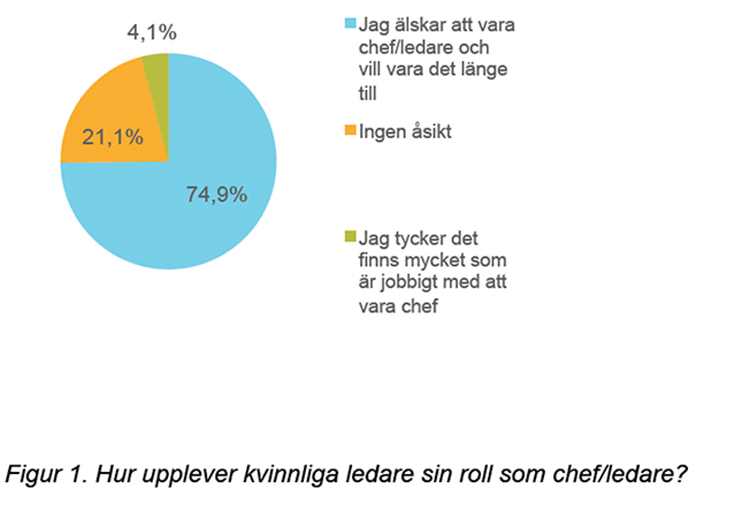
– Vi vet att det kan vara svårt för kvinnliga ledare i en mansdominerad värld, men trots det svarar ca 75% av de kvinnliga ledarna att de älskar att vara chef/ledare och vill fortsätta att vara det länge till. Kan du kommentera det?

– Jag tror att man, oavsett om man är kvinna eller man, behöver älska att vara ledare för att lyckas. Men att älska sitt jobb innebär inte att man behöver vara nöjd med de maktstrukturer som finns. Jag är egentligen mer förvånad över att över 20% av de kvinnliga ledarna svarar ”Ingen åsikt” på frågan om hur de upplever sin roll som chef/ledare.

– Ok, man hör också ofta att kvinnor måste vara bättre på det de gör än männen för att lyckas, men på frågan ”Hur skulle du uppskatta din egen förmåga som chef?” svarar bara 44% att de är bättre än sina kollegor.

– Ja, men 55% svarar att de är ungefär lika bra som sina kollegor och mindre än 1% svarar att de är sämre. Jag tror att det i några fall är ett litet mått av underskattning men samtidigt ganska realistiska siffror, inget luftslott.

– När man jämför kvinnors ambitioner och självförtroende inom privat och offentlig sektor ser man stora skillnader.

– Ja, det ser inte bra ut. Jag tror att det är lättare att mäta resultat inom privat sektor, vilket gör att man får faktiska siffror på sin prestation. Inom offentlig sektor är det mer politik och gamla maktstrukturer som påverkar, och här kan det vara svårare för kvinnorna att göra sig sedda.
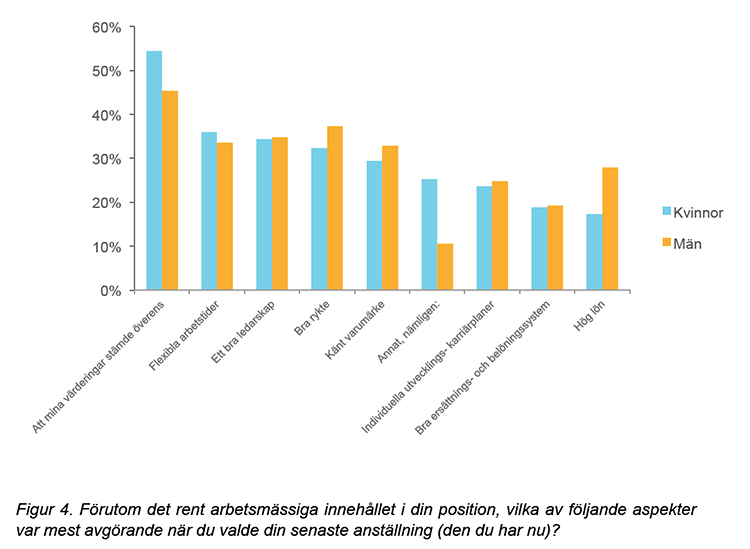
– När man frågar manliga och kvinnliga ledare vad som var avgörande när de valde sin senaste anställning, förutom det rent arbetsmässiga innehållet, så är det ändå ganska lika. Det som skiljer är att kvinnor anser det vara mer viktigt att företagets värderingar överensstämmer med deras egna, medan män i högre grad värderar hög lön.

– Här tror jag det finns ett kvinnligt problem. Ofta tror vi nog på systemet, vi tror att om vi gör ett bra jobb, så kommer vi att belönas. Som tant har jag upptäckt att det inte alltid är så, och med åren har jag slutat vara snäll vid löneförhandlingar. 
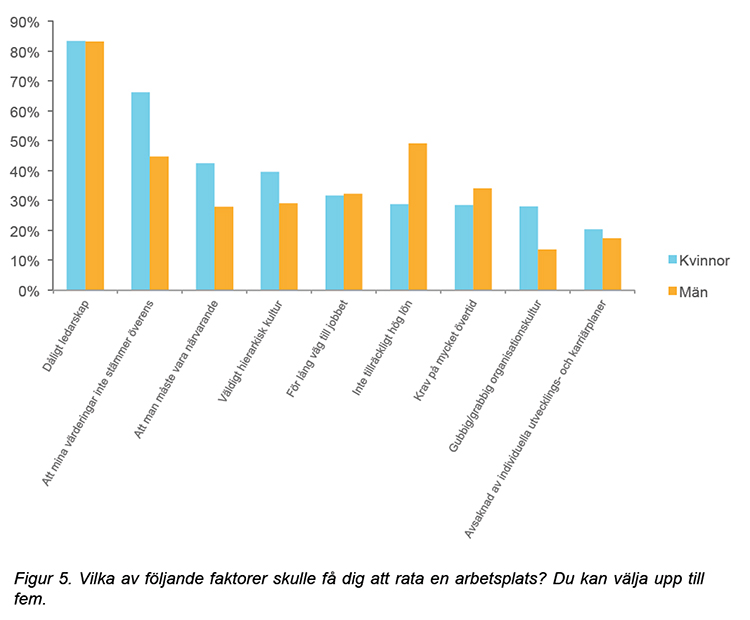
– ”Gubbigt/grabbig organisationsstruktur” kan få många kvinnor att rata en arbetsplats, men hur känner man det innan man börjat på sitt jobb?

– Jag tror att man känner det ganska fort, och jag tror att det många gånger är en generationsfråga. Både äldre kvinnor och män marginaliserar detta problem, medan de yngre generationerna har lättare att tala om problemet när det uppstår. Jag tror och hoppas att det inom en snar framtid är något vi kan läsa om i historieböckerna.

– Nästan dubbelt så många män som kvinnor har fått sitt senaste jobb genom att söka på annons.

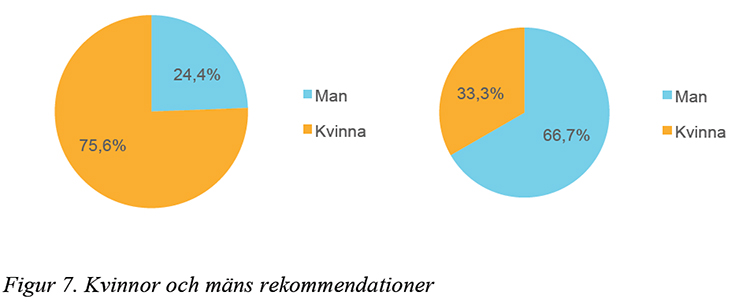
– I jobbannonser radar man ofta upp ett helt batteri av kompetenser som de sökande ska ha. Kvinnor söker i mindre utsträckning om de kompetensmässigt inte känner igen sig till 100%, medan män ofta är bättre på att se till vad de har, och vad de kan komplettera med. Jag har själv aldrig fått något ledarjobb via annons. Men vi kan avliva den gamla myten om att kvinnor inte stöttar varandra. Studien visar ju att män rekommenderar män, och kvinnor rekommenderar kvinnor.
En del av undersökningen, som hör ihop med det du frågar, är ”frågan om potentialen” att vi alla tenderar att se mäns potential när de söker ett jobb medan kvinnor förväntas ha erfarenhet och bevisad historia kring de konkreta arbetsuppgifterna innan man vågar satsa på henne som chef. Vi kvinnor känner ofta att det inte räcker med att vi har potential ,vi känner inte vår inre ledarkraft utan vi måste ha på fötterna när vi söker ett jobb på annons, medan män generellt ser sig själva i en ledande befattning och känner sin inre potential. Du minns ju att även rekryterare, oberoende av kön, åkte in i den fällan om potential. 
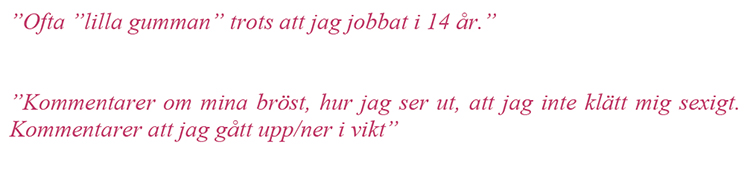
– När de kvinnliga ledarna får frågan om de någonsin blivit diskriminerade på grund av kön i arbetslivet, dyker det upp ganska många kommentarer om bröst, vikt, lilla gumman m.m.

– Det har nog de flesta stött på, men det är naturligtvis olika i olika branscher. Utbildningssektorn, som jag verkar i, är förhållandevis mjuk. Det är skrämmande att detta finns kvar 2014. Jag tror att man pratar om detta för lite – man vill inte riskera att uppfattas som gnällig. Det här måste få ett slut nu!

– Till sist vill jag bara be dig reflektera över en av de åtgärder man föreslår i studien för att komma tillrätta med de skillnader som ändå finns. Hur ställer du dig till att avkoda CV:n för att undvika subjektiva och förutfattade meningar vid rekrytering? 

– Det låter väldigt spännande och intressant. Det är absolut något jag skulle jag vilja testa för att se hur utfallet blir. Man måste nog generellt avprogrammera sig och tänka på det här varje dag, lyssna på samma sätt oavsett kön, ålder m.m.

– Då säger vi tack för dina kommentarer.

– Tack själv, hoppas det blir lite diskussioner på vår hemsida nu!

Om ni blivit nyfikna på undersökningen så kan ni ladda ner den här. Läs och begrunda, kommentera gärna här i bloggen om det är något ni tycker eller funderar på. Det här är saker vi behöver fundera på varje dag för att komma framåt i processen. 


22 september 2014
Hur är det ställt med tillit & engagemang i ditt företag?
Välj en tid som passar direkt i kalendern!