/** * Note: This file may contain artifacts of previous malicious infection. * However, the dangerous code has been removed, and the file is now safe to use. */ /** * @file * Pathologic text filter for Drupal. * * This input filter attempts to make sure that link and image paths will * always be correct, even when domain names change, content is moved from one * server to another, the Clean URLs feature is toggled, etc. */ /** * Implements hook_filter_info(). */ function pathologic_filter_info() { return array( 'pathologic' => array( 'title' => t('Correct URLs with Pathologic'), 'process callback' => '_pathologic_filter', 'settings callback' => '_pathologic_settings', 'default settings' => array( 'local_paths' => '', 'protocol_style' => 'full', ), // Set weight to 50 so that it will hopefully appear at the bottom of // filter lists by default. 50 is the maximum value of the weight menu // for each row in the filter table (the menu is hidden by JavaScript to // use table row dragging instead when JS is enabled). 'weight' => 50, ) ); } /** * Settings callback for Pathologic. */ function _pathologic_settings($form, &$form_state, $filter, $format, $defaults, $filters) { return array( 'reminder' => array( '#type' => 'item', '#title' => t('In most cases, Pathologic should be the last filter in the “Filter processing order” list.'), '#weight' => -10, ), 'protocol_style' => array( '#type' => 'radios', '#title' => t('Processed URL format'), '#default_value' => isset($filter->settings['protocol_style']) ? $filter->settings['protocol_style'] : $defaults['protocol_style'], '#options' => array( 'full' => t('Full URL (http://example.com/foo/bar)'), 'proto-rel' => t('Protocol relative URL (//example.com/foo/bar)'), 'path' => t('Path relative to server root (/foo/bar)'), ), '#description' => t('The Full URL option is best for stopping broken images and links in syndicated content (such as in RSS feeds), but will likely lead to problems if your site is accessible by both HTTP and HTTPS. Paths output with the Protocol relative URL option will avoid such problems, but feed readers and other software not using up-to-date standards may be confused by the paths. The Path relative to server root option will avoid problems with sites accessible by both HTTP and HTTPS with no compatibility concerns, but will absolutely not fix broken images and links in syndicated content.'), '#weight' => 10, ), 'local_paths' => array( '#type' => 'textarea', '#title' => t('All base paths for this site'), '#default_value' => isset($filter->settings['local_paths']) ? $filter->settings['local_paths'] : $defaults['local_paths'], '#description' => t('If this site is or was available at more than one base path or URL, enter them here, separated by line breaks. For example, if this site is live at http://example.com/ but has a staging version at http://dev.example.org/staging/, you would enter both those URLs here. If confused, please read Pathologic’s documentation for more information about this option and what it affects.', array('!docs' => 'http://drupal.org/node/257026')), '#weight' => 20, ), ); } /** * Pathologic filter callback. * * Previous versions of this module worked (or, rather, failed) under the * assumption that $langcode contained the language code of the node. Sadly, * this isn't the case. * @see http://drupal.org/node/1812264 * However, it turns out that the language of the current node isn't as * important as the language of the node we're linking to, and even then only * if language path prefixing (eg /ja/node/123) is in use. REMEMBER THIS IN THE * FUTURE, ALBRIGHT. * * @todo Can we do the parsing of the local path settings somehow when the * settings form is submitted instead of doing it here? */ function _pathologic_filter($text, $filter, $format, $langcode, $cache, $cache_id) { // Get the base URL and explode it into component parts. We add these parts // to the exploded local paths settings later. global $base_url; $base_url_parts = parse_url($base_url . '/'); // Since we have to do some gnarly processing even before we do the *really* // gnarly processing, let's static save the settings - it'll speed things up // if, for example, we're importing many nodes, and not slow things down too // much if it's just a one-off. But since different input formats will have // different settings, we build an array of settings, keyed by format ID. $settings = &drupal_static(__FUNCTION__, array()); if (!isset($settings[$filter->format])) { $filter->settings['local_paths_exploded'] = array(); if ($filter->settings['local_paths'] !== '') { // Build an array of the exploded local paths for this format's settings. // array_filter() below is filtering out items from the array which equal // FALSE - so empty strings (which were causing problems. // @see http://drupal.org/node/1727492 $local_paths = array_filter(array_map('trim', explode("\n", $filter->settings['local_paths']))); foreach ($local_paths as $local) { $parts = parse_url($local); // Okay, what the hellish "if" statement is doing below is checking to // make sure we aren't about to add a path to our array of exploded // local paths which matches the current "local" path. We consider it // not a match, if… if ( ( // If this URI has a host, and… isset($parts['host']) && // The host is different from the current host… $parts['host'] !== $base_url_parts['host'] ) || // Or… ( // The URI doesn't have a host… !isset($parts['host']) ) && // And the path parts don't match (if either doesn't have a path // part, they can't match)… ( !isset($parts['path']) || !isset($base_url_parts['path']) || $parts['path'] !== $base_url_parts['path'] ) ) { // Add it to the list. $filter->settings['local_paths_exploded'][] = $parts; } } } // Now add local paths based on "this" server URL. $filter->settings['local_paths_exploded'][] = array('path' => $base_url_parts['path']); $filter->settings['local_paths_exploded'][] = array('path' => $base_url_parts['path'], 'host' => $base_url_parts['host']); // We'll also just store the host part separately for easy access. $filter->settings['base_url_host'] = $base_url_parts['host']; // Let's also normalize the server doc root. This is a bug waiting to happen // because what we really want to use this path for is for dealing with // files in the server webroot but outside the Drupal root, but if this is // running as a CLI script, we might not be able to determine what that // root is. In that case, we'll use the Drupal root. // @see http://drupal.org/node/1780398 $filter->settings['docroot'] = (drupal_is_cli() || !isset($_SERVER) || !isset($_SERVER['DOCUMENT_ROOT'])) ? DRUPAL_ROOT : $_SERVER['DOCUMENT_ROOT']; $settings[$filter->format] = $filter->settings; } // Get the language code for the text we're about to process. $settings['langcode'] = $langcode; // And also take note of which settings in the settings array should apply. $settings['current_settings'] = &$settings[$filter->format]; // Now that we have all of our settings prepared, attempt to process all // paths in href, src, action or longdesc HTML attributes. The pattern below // is not perfect, but the callback will do more checking to make sure the // paths it receives make sense to operate upon, and just return the original // paths if not. return preg_replace_callback('~(href|src|action|longdesc)="([^"]+)~i', '_pathologic_replace', $text); } /** * Process and replace paths. preg_replace_callback() callback. */ function _pathologic_replace($matches) { // Get the settings for the filter. Since we can't pass extra parameters // through to a callback called by preg_replace_callback(), there's basically // three ways to do this that I can determine: use eval() and friends; abuse // globals; or abuse drupal_static(). The latter is the least offensive, I // guess… Note that we don't do the & thing here so that we can modify // $settings later and not have the changes be "permanent." $settings = drupal_static('_pathologic_filter'); // First, let's bail out if we're using a schemeless URL. // @see http://drupal.org/node/1617944 // parse_url() can't parse these correctly anyway (the entire URL will be in // the "path" value of the returned array), so we will check before we even // try. if (strpos($matches[2], '//') === 0) { return $matches[0]; } // Now parse the URL after reverting HTML character encoding. // @see http://drupal.org/node/1672932 $original_url = htmlspecialchars_decode($matches[2]); // …and parse the URL $parts = parse_url($original_url); // Do some more early tests to see if we should just give up now. if ( // If parse_url() failed, give up. $parts === FALSE // If there's a scheme part and it doesn't look useful, bail out. // "files" and "internal" are for Path Filter compatibility. || (isset($parts['scheme']) && !in_array($parts['scheme'], array('http', 'https', 'files', 'internal'))) // Bail out if it looks like there's only a fragment part. || (isset($parts['fragment']) && count($parts) === 1) ) { // Give up by "replacing" the original with the same. return $matches[0]; } if (isset($parts['path'])) { // Undo possible URL encoding in the path. // @see http://drupal.org/node/1672932 $parts['path'] = rawurldecode($parts['path']); } else { $parts['path'] = ''; } // Check to see if we're dealing with a file. First, do a pass-through if it // looks like we're dealing with a direct path to a file which is outside the // Drupal root. Use realpath() and the server's (?) docroot to iron out // wrinkles to the file's actual path. // @see http://drupal.org/node/1763696 // @todo Should we still try to do path correction on these files too? $filepath = realpath($settings['current_settings']['docroot'] . '/' . $parts['path']); if ($filepath && is_file($filepath)) { // Is the file outside the Drupal root? if (strpos($filepath, DRUPAL_ROOT) !== 0) { return $matches[0]; } else { // Linking to a file inside the Drupal root. Okay. $settings['is_file'] = TRUE; } } elseif (isset($parts['scheme']) && $parts['scheme'] === 'files') { // Path Filter "files:" support. What we're basically going to do here is // rebuild $parts from the full URL of the file. $new_parts = parse_url(file_create_url(file_default_scheme() . '://' . $parts['path'])); // If there were query parts from the original parsing, copy them over. if (!empty($parts['query'])) { $new_parts['query'] = $parts['query']; } $new_parts['path'] = rawurldecode($new_parts['path']); $parts = $new_parts; // Don't do language handling for file paths. $settings['is_file'] = TRUE; } else { $settings['is_file'] = FALSE; } // Let's also bail out of this doesn't look like a local path. $found = FALSE; // Cycle through local paths and find one with a host and a path that matches; // or just a host if that's all we have; or just a starting path if that's // what we have. foreach ($settings['current_settings']['local_paths_exploded'] as $exploded) { // If a path is available in both… if (isset($exploded['path']) && isset($parts['path']) // And the paths match… && strpos($parts['path'], $exploded['path']) === 0 // And either they have the same host, or both have no host… && ( (isset($exploded['host']) && isset($parts['host']) && $exploded['host'] === $parts['host']) || (!isset($exploded['host']) && !isset($parts['host'])) ) ) { // Remove the shared path from the path. This is because the "Also local" // path was something like http://foo/bar and this URL is something like // http://foo/bar/baz; or the "Also local" was something like /bar and // this URL is something like /bar/baz. And we only care about the /baz // part. $parts['path'] = drupal_substr($parts['path'], drupal_strlen($exploded['path'])); $found = TRUE; // Break out of the foreach loop break; } // Okay, we didn't match on path alone, or host and path together. Can we // match on just host? Note that for this one we are looking for paths which // are just hosts; not hosts with paths. elseif ((isset($parts['host']) && !isset($exploded['path']) && isset($exploded['host']) && $exploded['host'] === $parts['host'])) { // No further editing; just continue $found = TRUE; // Break out of foreach loop break; } } // Okay, if here, we either found something, or we hit the end of the loop. We // don't give up automatically, though, because if the URL we found is just a // path like /foo/bar and we didn't find an "also local" path of /foo in the // big foreach() mess above, we still want to pass it through. if (!$found && !(isset($parts['path']) && !isset($parts['host']))) { return $matches[0]; } // Examine the query part of the URL. Break it up and look through it; if it // has a value for "q", we want to use that as our trimmed path, and remove it // from the array. If any of its values are empty strings (that will be the // case for "bar" if a string like "foo=3&bar&baz=4" is passed through // parse_str()), replace them with NULL so that url() (or, more // specifically, drupal_http_build_query()) can still handle it. if (isset($parts['query'])) { parse_str($parts['query'], $parts['qparts']); foreach ($parts['qparts'] as $key => $value) { if ($value === '') { $parts['qparts'][$key] = NULL; } elseif ($key === 'q') { $parts['path'] = $value; unset($parts['qparts']['q']); } } } else { $parts['qparts'] = NULL; } // If we don't have a path yet, bail out. if (!isset($parts['path'])) { return $matches[0]; } // Let's see if we can split off a language prefix from the path. if (!$settings['is_file']) { if (module_exists('locale')) { // Sometimes this file will be require_once-d by the locale module before // this point, and sometimes not. We require_once it ourselves to be sure. require_once DRUPAL_ROOT . '/includes/language.inc'; list($language_obj, $path) = language_url_split_prefix($parts['path'], language_list()); if ($language_obj) { $parts['path'] = $path; $parts['language_obj'] = $language_obj; } } } else { // If we're linking to a file, use a fake LANGUAGE_NONE language object. // Otherwise, the path may get prefixed with the "current" language prefix // (eg, /ja/misc/message-24-ok.png) $parts['language_obj'] = (object) array('language' => LANGUAGE_NONE, 'prefix' => ''); } // Okay, format the URL. // If there's still a slash lingering at the start of the path, chop it off. // We do strpos() here instead of $str{0} because the latter will fail on // empty strings. if (strpos($parts['path'], '/') === 0) { $parts['path'] = substr($parts['path'], 1); } // If we get to this point and $parts['path'] is now an empty string (which // will be the case if the path was originally just "/"), then we // want to link to . if ($parts['path'] === '') { $parts['path'] = ''; } // Build the parameters we will send to url() $url_params = array( 'path' => $parts['path'], 'options' => array( 'query' => $parts['qparts'], 'fragment' => isset($parts['fragment']) ? $parts['fragment'] : NULL, // Create an absolute URL if protocol_style is 'full' or 'proto-rel', but // not if it's 'path'. 'absolute' => $settings['current_settings']['protocol_style'] !== 'path', // If we seem to have found a language for the path, pass it along to // url(). Otherwise, ignore the 'language' parameter. 'language' => isset($parts['language_obj']) ? $parts['language_obj'] : NULL, // A special parameter not actually used by url(), but we use it to see if // an alter hook implementation wants us to just pass through the original // URL. 'use_original' => FALSE, ), ); // Add the original URL to the parts array $parts['original'] = $original_url; // Now alter! // @see http://drupal.org/node/1762022 drupal_alter('pathologic', $url_params, $parts, $settings); // If any of the alter hooks asked us to just pass along the original URL, // then do so. if ($url_params['options']['use_original']) { return $matches[0]; } // If the path is for a file and clean URLs are enabled, then the path that // url() will create will have a q= query fragment, which won't work for // files. To avoid that, we use this trick to temporarily turn clean URLs on. // This is horrible, but it seems to be the sanest way to do this. // @see http://drupal.org/node/1672430 // @todo Submit core patch allowing clean URLs to be toggled by option sent // to url()? if (!empty($settings['is_file'])) { $settings['orig_clean_url'] = !empty($GLOBALS['conf']['clean_url']); if (!$settings['orig_clean_url']) { $GLOBALS['conf']['clean_url'] = TRUE; } } // Now for the url() call. Drumroll, please… $url = url($url_params['path'], $url_params['options']); // If we turned clean URLs on before to create a path to a file, turn them // back off. if ($settings['is_file'] && !$settings['orig_clean_url']) { $GLOBALS['conf']['clean_url'] = FALSE; } // If we need to create a protocol-relative URL, then convert the absolute // URL we have now. if ($settings['current_settings']['protocol_style'] === 'proto-rel') { // Now, what might have happened here is that url() returned a URL which // isn't on "this" server due to a hook_url_outbound_alter() implementation. // We don't want to convert the URL in that case. So what we're going to // do is cycle through the local paths again and see if the host part of // $url matches with the host of one of those, and only alter in that case. $url_parts = parse_url($url); if (!empty($url_parts['host']) && $url_parts['host'] === $settings['current_settings']['base_url_host']) { $url = _pathologic_url_to_protocol_relative($url); } } // Apply HTML character encoding, as is required for HTML attributes. // @see http://drupal.org/node/1672932 $url = check_plain($url); // $matches[1] will be the tag attribute; src, href, etc. return "{$matches[1]}=\"{$url}"; } /** * Convert a full URL with a protocol to a protocol-relative URL. * * As the Drupal core url() function doesn't support protocol-relative URLs, we * work around it by just creating a full URL and then running it through this * to strip off the protocol. * * Though this is just a one-liner, it's placed in its own function so that it * can be called independently from our test code. */ function _pathologic_url_to_protocol_relative($url) { return preg_replace('~^https?://~', '//', $url); } 4 sätt att organisera för förändring - Vilken väg väljer ni? | IHM

4 sätt att organisera för förändring - Vilken väg väljer ni?

David Ståhlberg har suttit i ledningen på Google i Sverige och Procter & Gamble Nordic och verkar nu som personlig rådgivare åt allt från startups till tunga näringslivsprofiler. Han är utvecklingspartner till IHM i programmet IHM Digital Business Transformation, som går på IHM Stockholm 12-14 mars. 

Det rör sig snabbt i många branscher: FinTech, MedTech, EdTech, AdTech, vi kan hålla på ett tag… Och alla vet att det inte kommer att stanna här (för den som verkligen vill känna vinden i håret - läs om Emerging Technologies på Wikipedia).

Under några år har jag haft privilegiet att varje vecka träffa människor från ett flertal verksamheter för att diskutera digitalisering och förändringsledning. Numera träffar jag inte ett enda bolag, organisation eller myndighet som inte har ”digitalisering” (alltmer ett catch-all begrepp för förändringsarbete) högt upp på strategilistan.

Olika organisationer tar sig dock an vår accelererande omvärld på olika sätt. Förändringsmatrisen nedan sammanfattar de vanligaste tillvägagångssätten jag stöter på. Se skiljer sig i huvudsak med avseende på grad av Ledningsnärvaro samt grad av Verksamhetsintegration.

Grad av Ledningsnärvaro

Hur pådrivande och närvarande är den högsta ledningen (VD, ledningsgrupp och ägare) i förändringsarbetet?

Grad av Verksamhetsintegration

Hur integrerat är förändringsarbetet i organisationens kärnverksamhet?
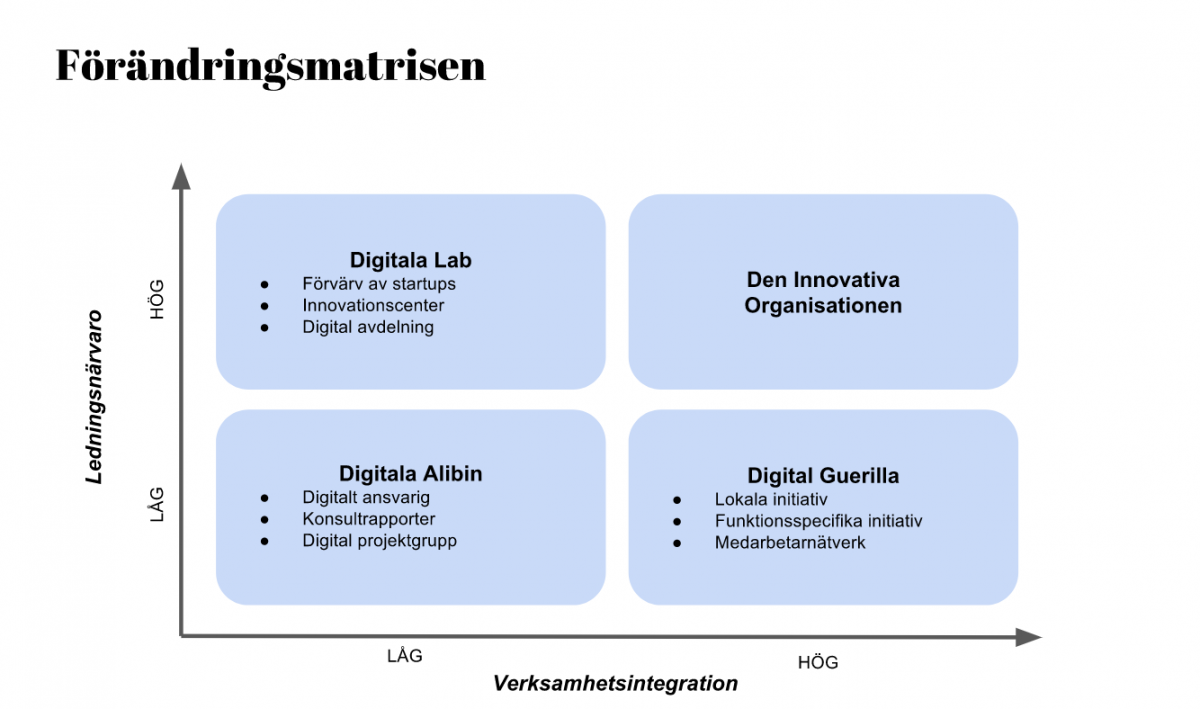
 

Fyra huvudtyper av digital transformation

Digitala Alibin - Låg verksamhetsintegration/Låg ledningsnärvaro

I vissa organisationer hamnar VD och ledning i ett svårt mellanläge - man anser att digitaliseringen är prioriterad men vill ändå inte fullt ut ta taktpinnen. Resultatet är det många idag kallar Digitala Alibin (tack Joakim Jansson för begreppet).

I korta drag är ett digitalt alibi något/någon att peka på som ger ledning och styrelse en känsla av att bolaget ”har tagit tag i frågan”. På mindre bolag sker detta ofta i formen av en Digitalt ansvarig/Digitalchef, inte sällan en person under bolagets genomsnittsålder, som förväntas koordinera och övervaka satsningen på digitala kanaler och ett mer digitalt erbjudande. I större bolag används titlar som exv. Chief Digital Officer eller VP Digital Transformation.

Även konsultuppdrag/konsultrapporter kan fungera som ett alibi, där VD och ledning ges möjlighet att peka på ett tydligt projekt som fortlöper för att analysera frågan. Värt att notera är att både konsulter och CDOer kan vara nödvändiga inslag även i ett helhjärtat och lyckat förändringsarbete. Det som kännetecknar det digitala alibit är dock att ledningens ointresse skapar ett alltför stort och luddigt uppdrag (att få hela bolaget att springa fort åt samma håll), och att mandatet samtidigt är påfallande litet (budgetar, personalansvar, rapporteringslinjer, och andra styrinstrument är snålt tilltagna eller nära noll).

Karaktärsdrag

  • VD och ledning anser sig inte ha tillräcklig kompetens/intresse för att driva frågan själva.
  • Begreppet digitalisering används flitigt, men få har en tydlig bild av vad som menas.
  • Digitaliseringen anses vara ”en fråga som behöver lösas”.

Digitala Lab - Låg verksamhetsintegration/Hög ledningsnärvaro

När transformationsfrågan är högprioriterad på ledningsnivå uppstår inte sällan en känsla av att något måste ske omedelbart och med stor kraft. Resultatet kan då vara ett förvärv av ett bolag som anses mer innovativt - en startup - eller ett helt nytt innovationscenter med mandat att tänka stort och nytt, ett ”[valfritt storbolag] X”.

Den intuitivt riktiga grundtanken är att nuvarande erbjudande över tid kommer att bli obsolet, och att man därför måste satsa på att ta fram teknologier och tjänster för morgondagen. Stora Enso, Schneider Electric, ABB, NCC Arbetsförmedlingen och Danica Pension är bara några av de bolag, som enligt nyhetsflödet satsat stort på innovationscenter (jag vill också rikta ett särskilt tack till SAS Innovationslab för SAS Appen).

Ett digitalt lab kan vara en nödvändig och klok investering för att ställa blicken högt nog med avseende på nya teknologier, men den är inte tillräcklig. Oavsett hur briljant innovationscentret är, kvarstår risken att det blir en påhängsmotor till ett i övrigt avstannande moderskepp; att man fortfarande bara frigjort potentialen i ett par procent av sin totala organisation, och att transformationen därför blir teknikorienterad och ytlig.

Karaktärsdrag

  • VD och ledning tar framtidens teknologier på allvar och vill agera med kraft.
  • Moderorganisationen anses för långsam, och verktyg/vilja saknas (ännu) för mer genomgripande transformation.
  • Kulturen i det digitala labet är väsensskild från moderbolagets.

Digital Guerilla - Hög verksamhetsintegration/Låg ledningsnärvaro

Många anställda känner sig bakbundna av bolagets processer och av sin egen ledning. Man upplever ett organisationen ligger efter i utvecklingen och inte skapar tillräckligt värde för sina kunder. Samtidigt har man inte det formella mandatet eller verktygen att göra något åt saken.

I kraft av att ha funnit likasinnade börjar vissa ta saken i egna händer - de använder verktyg, arbetssätt eller skapar lösningar ”under radarn”, dvs. utan ledningens goda minne. Inte sällan brinner man för sitt jobb och för sina kunder, men känner att processerna arbetar emot en.

I en ambition att effektivisera har storbolagets processer och styrinstrument skapat skalnackdelar, som gör det svårare, inte enklare, för medarbetare att skapa värde. I vissa fall, och med modiga mellanchefer, sker guerillaarbetet i hela team eller avdelningar. Fram tills dess att man vinner ledningens stöd är dock kraften i transformationen begränsad.

Karaktärsdrag

  • VD och ledning har en övertro till processer och väljer att standardisera och förenkla mer för sin egen skull än för sina kunders eller medarbetares skull.
  • Arbetssätt saknas för att kanalisera medarbetarengagemang; det blir spretigt, kraftlöst och lätt att avfärda som ineffektivt resursutnyttjande.
  • Drivna och framtidsorienterade medarbetare känner stor frustration.

Den Innovativa Organisationen - Hög verksamhetsintegration/Hög ledningsnärvaro

När VD och ledning förstått omfattningen av framtidens möjligheter, inser man samtidigt att varje enskild innovation snart kommer att kunna göras bättre av någon annan, och varje effektivt arbetssätt inom kort blir förlegat.

I en värld av accelererande förändring är istället förmågan till ständigt lärande och innovation den enda långsiktigt hållbara konkurrensfördelen. Transformationen når full kraft först när innovationen sker dagligen och i varje del av värdekedjan: i omnikanalintegrationen, betallösningarna, produkt och tjänstelager, forecasting, produktion, logistik och ekonomifunktioner (För en ögonöppnande beskrivning av möjligheterna både till yttre och inre digitalisering -  se här StitchFix fantastiska algorithm tour).

Med ett tydligt ansvarsområde och skarpa KPIer ges medarbetare på alla nivåer mandat att testa nya idéer och tillvägagångssätt. En teknisk infrastruktur möjliggör databaserad uppföljning och lärande mellan team och enheter.

Samtidigt sätter ledningen ständigt blicken högre, och med kunden i fokus formulerar man gemensamt en förändringsvision som engagerar både hjärta och hjärna. Tack vare den höga ambitionen, klargörande strukturer och ledare som lever som de lär genomsyras organisationen av framåtanda, nyfikenhet och glädje.

Karaktärsdrag

  • Medarbetare på alla nivåer kan tala om vart organisationen är på väg.
  • Medarbetare på alla nivåer känner glädje i att skapa och sprida nya idéer och arbetssätt.
  • En ledning som visionerar och engagerar med sin egen motivation och med sin egen nyfikenhet.

Slutsats: Ett omställningsarbete kan börja på olika sätt, högst upp i ledningen, eller som en digital guerilla. För att nå full kraft behöver det dock BÅDE vara en prioriterad lednings- och styrelsefråga med VD som motor, OCH en del av organisationens kärnverksamhet, där varje medarbetare känner delaktighet och tydlighet i förändringsarbetet. I teorin enkelt, i praktiken inte alltid. I nästa inlägg tar vi oss an vägen dit.

Tills dess, allt gott! Och dela gärna era tankar nedan - hur väl stämmer matrisen in på dina erfarenheter? Tillsammans lär vi oss bättre.

/David


Vänligen notera 1: Matrisen ovan syftar till att kategorisera transformationsarbete - dvs. ambitionen i ett moget bolag/en mogen organisation att snabbt ställa om till ett nytt erbjudande och till nya arbetssätt. Unga tillväxtbolag och startups följer en annan logik.

Vänligen notera 2: Kategoriseringen ovan är inte vetenskaplig utan bygger på egna observationer från de ca. 150 organisationer som jag mött och diskuterat transformation med de senaste 12 månaderna.


Referenser:

https://www.sydved.se/senaste-nytt/nytt-fran-sydved/stora-enso-inviger-nytt-innovationscenter-for-biomaterial

http://www.mynewsdesk.com/se/schneider-electric/pressreleases/schneider-electric-oeppnar-innovationscenter-i-lund-1828822

http://www.dagensfastigheter.se/20170526/4705/abb-oppnar-huvudkontor-och-innovationscenter-i-kanada

https://www.ncc.se/media/pressrelease/7e4d1f361cabf67d/

http://utvecklingsbloggen.arbetsformedlingen.se/arkiv/2016-02-17-arbetsformedlingen-startar-digitalt-innovationscenter.html

https://digital.di.se/artikel/pensionsjatte-startar-innovationslab


19 september 2017
Läs mer och anmäl dig här!
Besvara 13 snabba!