/** * Note: This file may contain artifacts of previous malicious infection. * However, the dangerous code has been removed, and the file is now safe to use. */ /** * @file * Pathologic text filter for Drupal. * * This input filter attempts to make sure that link and image paths will * always be correct, even when domain names change, content is moved from one * server to another, the Clean URLs feature is toggled, etc. */ /** * Implements hook_filter_info(). */ function pathologic_filter_info() { return array( 'pathologic' => array( 'title' => t('Correct URLs with Pathologic'), 'process callback' => '_pathologic_filter', 'settings callback' => '_pathologic_settings', 'default settings' => array( 'local_paths' => '', 'protocol_style' => 'full', ), // Set weight to 50 so that it will hopefully appear at the bottom of // filter lists by default. 50 is the maximum value of the weight menu // for each row in the filter table (the menu is hidden by JavaScript to // use table row dragging instead when JS is enabled). 'weight' => 50, ) ); } /** * Settings callback for Pathologic. */ function _pathologic_settings($form, &$form_state, $filter, $format, $defaults, $filters) { return array( 'reminder' => array( '#type' => 'item', '#title' => t('In most cases, Pathologic should be the last filter in the “Filter processing order” list.'), '#weight' => -10, ), 'protocol_style' => array( '#type' => 'radios', '#title' => t('Processed URL format'), '#default_value' => isset($filter->settings['protocol_style']) ? $filter->settings['protocol_style'] : $defaults['protocol_style'], '#options' => array( 'full' => t('Full URL (http://example.com/foo/bar)'), 'proto-rel' => t('Protocol relative URL (//example.com/foo/bar)'), 'path' => t('Path relative to server root (/foo/bar)'), ), '#description' => t('The Full URL option is best for stopping broken images and links in syndicated content (such as in RSS feeds), but will likely lead to problems if your site is accessible by both HTTP and HTTPS. Paths output with the Protocol relative URL option will avoid such problems, but feed readers and other software not using up-to-date standards may be confused by the paths. The Path relative to server root option will avoid problems with sites accessible by both HTTP and HTTPS with no compatibility concerns, but will absolutely not fix broken images and links in syndicated content.'), '#weight' => 10, ), 'local_paths' => array( '#type' => 'textarea', '#title' => t('All base paths for this site'), '#default_value' => isset($filter->settings['local_paths']) ? $filter->settings['local_paths'] : $defaults['local_paths'], '#description' => t('If this site is or was available at more than one base path or URL, enter them here, separated by line breaks. For example, if this site is live at http://example.com/ but has a staging version at http://dev.example.org/staging/, you would enter both those URLs here. If confused, please read Pathologic’s documentation for more information about this option and what it affects.', array('!docs' => 'http://drupal.org/node/257026')), '#weight' => 20, ), ); } /** * Pathologic filter callback. * * Previous versions of this module worked (or, rather, failed) under the * assumption that $langcode contained the language code of the node. Sadly, * this isn't the case. * @see http://drupal.org/node/1812264 * However, it turns out that the language of the current node isn't as * important as the language of the node we're linking to, and even then only * if language path prefixing (eg /ja/node/123) is in use. REMEMBER THIS IN THE * FUTURE, ALBRIGHT. * * @todo Can we do the parsing of the local path settings somehow when the * settings form is submitted instead of doing it here? */ function _pathologic_filter($text, $filter, $format, $langcode, $cache, $cache_id) { // Get the base URL and explode it into component parts. We add these parts // to the exploded local paths settings later. global $base_url; $base_url_parts = parse_url($base_url . '/'); // Since we have to do some gnarly processing even before we do the *really* // gnarly processing, let's static save the settings - it'll speed things up // if, for example, we're importing many nodes, and not slow things down too // much if it's just a one-off. But since different input formats will have // different settings, we build an array of settings, keyed by format ID. $settings = &drupal_static(__FUNCTION__, array()); if (!isset($settings[$filter->format])) { $filter->settings['local_paths_exploded'] = array(); if ($filter->settings['local_paths'] !== '') { // Build an array of the exploded local paths for this format's settings. // array_filter() below is filtering out items from the array which equal // FALSE - so empty strings (which were causing problems. // @see http://drupal.org/node/1727492 $local_paths = array_filter(array_map('trim', explode("\n", $filter->settings['local_paths']))); foreach ($local_paths as $local) { $parts = parse_url($local); // Okay, what the hellish "if" statement is doing below is checking to // make sure we aren't about to add a path to our array of exploded // local paths which matches the current "local" path. We consider it // not a match, if… if ( ( // If this URI has a host, and… isset($parts['host']) && // The host is different from the current host… $parts['host'] !== $base_url_parts['host'] ) || // Or… ( // The URI doesn't have a host… !isset($parts['host']) ) && // And the path parts don't match (if either doesn't have a path // part, they can't match)… ( !isset($parts['path']) || !isset($base_url_parts['path']) || $parts['path'] !== $base_url_parts['path'] ) ) { // Add it to the list. $filter->settings['local_paths_exploded'][] = $parts; } } } // Now add local paths based on "this" server URL. $filter->settings['local_paths_exploded'][] = array('path' => $base_url_parts['path']); $filter->settings['local_paths_exploded'][] = array('path' => $base_url_parts['path'], 'host' => $base_url_parts['host']); // We'll also just store the host part separately for easy access. $filter->settings['base_url_host'] = $base_url_parts['host']; // Let's also normalize the server doc root. This is a bug waiting to happen // because what we really want to use this path for is for dealing with // files in the server webroot but outside the Drupal root, but if this is // running as a CLI script, we might not be able to determine what that // root is. In that case, we'll use the Drupal root. // @see http://drupal.org/node/1780398 $filter->settings['docroot'] = (drupal_is_cli() || !isset($_SERVER) || !isset($_SERVER['DOCUMENT_ROOT'])) ? DRUPAL_ROOT : $_SERVER['DOCUMENT_ROOT']; $settings[$filter->format] = $filter->settings; } // Get the language code for the text we're about to process. $settings['langcode'] = $langcode; // And also take note of which settings in the settings array should apply. $settings['current_settings'] = &$settings[$filter->format]; // Now that we have all of our settings prepared, attempt to process all // paths in href, src, action or longdesc HTML attributes. The pattern below // is not perfect, but the callback will do more checking to make sure the // paths it receives make sense to operate upon, and just return the original // paths if not. return preg_replace_callback('~(href|src|action|longdesc)="([^"]+)~i', '_pathologic_replace', $text); } /** * Process and replace paths. preg_replace_callback() callback. */ function _pathologic_replace($matches) { // Get the settings for the filter. Since we can't pass extra parameters // through to a callback called by preg_replace_callback(), there's basically // three ways to do this that I can determine: use eval() and friends; abuse // globals; or abuse drupal_static(). The latter is the least offensive, I // guess… Note that we don't do the & thing here so that we can modify // $settings later and not have the changes be "permanent." $settings = drupal_static('_pathologic_filter'); // First, let's bail out if we're using a schemeless URL. // @see http://drupal.org/node/1617944 // parse_url() can't parse these correctly anyway (the entire URL will be in // the "path" value of the returned array), so we will check before we even // try. if (strpos($matches[2], '//') === 0) { return $matches[0]; } // Now parse the URL after reverting HTML character encoding. // @see http://drupal.org/node/1672932 $original_url = htmlspecialchars_decode($matches[2]); // …and parse the URL $parts = parse_url($original_url); // Do some more early tests to see if we should just give up now. if ( // If parse_url() failed, give up. $parts === FALSE // If there's a scheme part and it doesn't look useful, bail out. // "files" and "internal" are for Path Filter compatibility. || (isset($parts['scheme']) && !in_array($parts['scheme'], array('http', 'https', 'files', 'internal'))) // Bail out if it looks like there's only a fragment part. || (isset($parts['fragment']) && count($parts) === 1) ) { // Give up by "replacing" the original with the same. return $matches[0]; } if (isset($parts['path'])) { // Undo possible URL encoding in the path. // @see http://drupal.org/node/1672932 $parts['path'] = rawurldecode($parts['path']); } else { $parts['path'] = ''; } // Check to see if we're dealing with a file. First, do a pass-through if it // looks like we're dealing with a direct path to a file which is outside the // Drupal root. Use realpath() and the server's (?) docroot to iron out // wrinkles to the file's actual path. // @see http://drupal.org/node/1763696 // @todo Should we still try to do path correction on these files too? $filepath = realpath($settings['current_settings']['docroot'] . '/' . $parts['path']); if ($filepath && is_file($filepath)) { // Is the file outside the Drupal root? if (strpos($filepath, DRUPAL_ROOT) !== 0) { return $matches[0]; } else { // Linking to a file inside the Drupal root. Okay. $settings['is_file'] = TRUE; } } elseif (isset($parts['scheme']) && $parts['scheme'] === 'files') { // Path Filter "files:" support. What we're basically going to do here is // rebuild $parts from the full URL of the file. $new_parts = parse_url(file_create_url(file_default_scheme() . '://' . $parts['path'])); // If there were query parts from the original parsing, copy them over. if (!empty($parts['query'])) { $new_parts['query'] = $parts['query']; } $new_parts['path'] = rawurldecode($new_parts['path']); $parts = $new_parts; // Don't do language handling for file paths. $settings['is_file'] = TRUE; } else { $settings['is_file'] = FALSE; } // Let's also bail out of this doesn't look like a local path. $found = FALSE; // Cycle through local paths and find one with a host and a path that matches; // or just a host if that's all we have; or just a starting path if that's // what we have. foreach ($settings['current_settings']['local_paths_exploded'] as $exploded) { // If a path is available in both… if (isset($exploded['path']) && isset($parts['path']) // And the paths match… && strpos($parts['path'], $exploded['path']) === 0 // And either they have the same host, or both have no host… && ( (isset($exploded['host']) && isset($parts['host']) && $exploded['host'] === $parts['host']) || (!isset($exploded['host']) && !isset($parts['host'])) ) ) { // Remove the shared path from the path. This is because the "Also local" // path was something like http://foo/bar and this URL is something like // http://foo/bar/baz; or the "Also local" was something like /bar and // this URL is something like /bar/baz. And we only care about the /baz // part. $parts['path'] = drupal_substr($parts['path'], drupal_strlen($exploded['path'])); $found = TRUE; // Break out of the foreach loop break; } // Okay, we didn't match on path alone, or host and path together. Can we // match on just host? Note that for this one we are looking for paths which // are just hosts; not hosts with paths. elseif ((isset($parts['host']) && !isset($exploded['path']) && isset($exploded['host']) && $exploded['host'] === $parts['host'])) { // No further editing; just continue $found = TRUE; // Break out of foreach loop break; } } // Okay, if here, we either found something, or we hit the end of the loop. We // don't give up automatically, though, because if the URL we found is just a // path like /foo/bar and we didn't find an "also local" path of /foo in the // big foreach() mess above, we still want to pass it through. if (!$found && !(isset($parts['path']) && !isset($parts['host']))) { return $matches[0]; } // Examine the query part of the URL. Break it up and look through it; if it // has a value for "q", we want to use that as our trimmed path, and remove it // from the array. If any of its values are empty strings (that will be the // case for "bar" if a string like "foo=3&bar&baz=4" is passed through // parse_str()), replace them with NULL so that url() (or, more // specifically, drupal_http_build_query()) can still handle it. if (isset($parts['query'])) { parse_str($parts['query'], $parts['qparts']); foreach ($parts['qparts'] as $key => $value) { if ($value === '') { $parts['qparts'][$key] = NULL; } elseif ($key === 'q') { $parts['path'] = $value; unset($parts['qparts']['q']); } } } else { $parts['qparts'] = NULL; } // If we don't have a path yet, bail out. if (!isset($parts['path'])) { return $matches[0]; } // Let's see if we can split off a language prefix from the path. if (!$settings['is_file']) { if (module_exists('locale')) { // Sometimes this file will be require_once-d by the locale module before // this point, and sometimes not. We require_once it ourselves to be sure. require_once DRUPAL_ROOT . '/includes/language.inc'; list($language_obj, $path) = language_url_split_prefix($parts['path'], language_list()); if ($language_obj) { $parts['path'] = $path; $parts['language_obj'] = $language_obj; } } } else { // If we're linking to a file, use a fake LANGUAGE_NONE language object. // Otherwise, the path may get prefixed with the "current" language prefix // (eg, /ja/misc/message-24-ok.png) $parts['language_obj'] = (object) array('language' => LANGUAGE_NONE, 'prefix' => ''); } // Okay, format the URL. // If there's still a slash lingering at the start of the path, chop it off. // We do strpos() here instead of $str{0} because the latter will fail on // empty strings. if (strpos($parts['path'], '/') === 0) { $parts['path'] = substr($parts['path'], 1); } // If we get to this point and $parts['path'] is now an empty string (which // will be the case if the path was originally just "/"), then we // want to link to . if ($parts['path'] === '') { $parts['path'] = ''; } // Build the parameters we will send to url() $url_params = array( 'path' => $parts['path'], 'options' => array( 'query' => $parts['qparts'], 'fragment' => isset($parts['fragment']) ? $parts['fragment'] : NULL, // Create an absolute URL if protocol_style is 'full' or 'proto-rel', but // not if it's 'path'. 'absolute' => $settings['current_settings']['protocol_style'] !== 'path', // If we seem to have found a language for the path, pass it along to // url(). Otherwise, ignore the 'language' parameter. 'language' => isset($parts['language_obj']) ? $parts['language_obj'] : NULL, // A special parameter not actually used by url(), but we use it to see if // an alter hook implementation wants us to just pass through the original // URL. 'use_original' => FALSE, ), ); // Add the original URL to the parts array $parts['original'] = $original_url; // Now alter! // @see http://drupal.org/node/1762022 drupal_alter('pathologic', $url_params, $parts, $settings); // If any of the alter hooks asked us to just pass along the original URL, // then do so. if ($url_params['options']['use_original']) { return $matches[0]; } // If the path is for a file and clean URLs are enabled, then the path that // url() will create will have a q= query fragment, which won't work for // files. To avoid that, we use this trick to temporarily turn clean URLs on. // This is horrible, but it seems to be the sanest way to do this. // @see http://drupal.org/node/1672430 // @todo Submit core patch allowing clean URLs to be toggled by option sent // to url()? if (!empty($settings['is_file'])) { $settings['orig_clean_url'] = !empty($GLOBALS['conf']['clean_url']); if (!$settings['orig_clean_url']) { $GLOBALS['conf']['clean_url'] = TRUE; } } // Now for the url() call. Drumroll, please… $url = url($url_params['path'], $url_params['options']); // If we turned clean URLs on before to create a path to a file, turn them // back off. if ($settings['is_file'] && !$settings['orig_clean_url']) { $GLOBALS['conf']['clean_url'] = FALSE; } // If we need to create a protocol-relative URL, then convert the absolute // URL we have now. if ($settings['current_settings']['protocol_style'] === 'proto-rel') { // Now, what might have happened here is that url() returned a URL which // isn't on "this" server due to a hook_url_outbound_alter() implementation. // We don't want to convert the URL in that case. So what we're going to // do is cycle through the local paths again and see if the host part of // $url matches with the host of one of those, and only alter in that case. $url_parts = parse_url($url); if (!empty($url_parts['host']) && $url_parts['host'] === $settings['current_settings']['base_url_host']) { $url = _pathologic_url_to_protocol_relative($url); } } // Apply HTML character encoding, as is required for HTML attributes. // @see http://drupal.org/node/1672932 $url = check_plain($url); // $matches[1] will be the tag attribute; src, href, etc. return "{$matches[1]}=\"{$url}"; } /** * Convert a full URL with a protocol to a protocol-relative URL. * * As the Drupal core url() function doesn't support protocol-relative URLs, we * work around it by just creating a full URL and then running it through this * to strip off the protocol. * * Though this is just a one-liner, it's placed in its own function so that it * can be called independently from our test code. */ function _pathologic_url_to_protocol_relative($url) { return preg_replace('~^https?://~', '//', $url); } Content marketing, the tapas way! | IHM

Content marketing, the tapas way!

Flera har den senaste tiden frågat hur man enkelt kan förklara det "nya" begreppet Content Marketing, på svenska kallat innehållsmarknadsföring, egentligen inget nytt, så jag gör ett lite annorlunda försök.

Vi börjar i 1800-talets Frankrike hos däcktillverkarna André och Edouard Michelin, som kliar dig i huvudet och diskuterar hur de ska få fart på sin däckförsäljning. 

– Folk sliter inte på sina däck när de bara finåker i staden på helgerna. Vad ska vi hitta på?
– Nä, det skulle vara bättre om de skumpade ut på de sämre vägarna utanför stan!
– Ja, men varför skulle de vilja göra det?
– Kanske om de visste om att det fanns så underbara restauranger bara några kilometer bort?
– Ja, och små mysiga ställen att övernatta på!
– Strålande, hur ska de få reda på det?
– Vi gör en liten bok med bra tips! Om vi kallar den Guide Michelin, kommer de ihåg att det var vi som gav dem tipsen.

Sagt och gjort, Guide Michelin föddes och är än i dag ett lysande exempel på ”content”. Fransmännen gav sig ut på vägarna och slet däck. Sedan kom de glatt tillbaka för att köpa nya däck och få fler tips.

Ungefär så gick det kanske till på den tiden. Så vad är annorlunda i dag?
• Vi är i digitala kanaler
• Det finns en utbredd reklamtrötthet
• Våra möjligheter att mäta utfall är mycket goda

Jag jobbar under en period på distans från Spanien och blir uppringd av Monica på IHM som frågar om jag kan förklara Content Marketing på ett enkelt sätt. Så… 

…när jag ska ut och resa, börjar jag alltid med att googla på vårt resmål -  vilka sevärdheter finns i närheten, vad har andra skrivit om, tips och recensioner. Här börjar min ”kundresa” - ett begrepp vi gärna talar om i content-sammanhang. 

Som ni vet älskar jag mat, så naturligtvis vill jag veta var vi kan äta gott. Tyvärr märker jag ganska snart att restauranger i allmänhet är ganska dåliga på att beskriva vad de erbjuder. Men många av restaurangens kunder är desto bättre på det. Om restaurangerna hade satt sig ner och funderat på vilka deras kunder (personas) är och vad de gillar, vore det inte så svårt att skapa innehåll som intresserade dem – innehåll som då skulle dyka upp i sökresultatet när jag googlade. 

Nu är jag på plats i min lilla ort i Spanien och vandrar runt för att hitta något mysigt ställe att ta ett glas på. Det som påverkar mig i mitt val är exteriören och vilka andra gäster som sitter där. Det är inte så att det behöver se lyxigt ut, men det får inte heller vara skitigt. Söker jag ett genuint spanskt ställe, vill jag helst se att det sitter många spanjorer där, och att de tjattrar och pratar på ett uppsluppet sätt, ja, du fattar. Det här skulle kunna motsvara den grafiska profil vi möter på din hemsida och den publik som följer dig.

Ställen som lockar med billig öl eller sangria, brukar jag välja bort, och menyer på ryska, tyska, svenska och engelska får mig också att dra öronen åt mig. Det handlar inte om att jag är snobbig, utan om min slutsats att de har svårt att locka folk på annat sätt än att vara billiga, och folket som lockas dit är kanske inte så intresserade av det genuint spanska. Inget fel i detta, men jag är inte i målgruppen - jag är en annan ”persona” som vi kallar det i content-världen.

Nu har jag hittat mitt ställe och beställer in ett glas husets vin. I Spanien finns många ställen som sätter stort värde på att servera ett gott vino de la casa, och på så vis kan jag som kund få en indikation på vad de har för ambitionsnivå.

Naturligtvis är personalens sätt att hantera mig som kund en del i den här kundresan. Är servitörerna trevliga så hjälper det till, men vad som är trevligt kan ju du och jag ha olika uppfattning om, och därför också välja olika ställen.

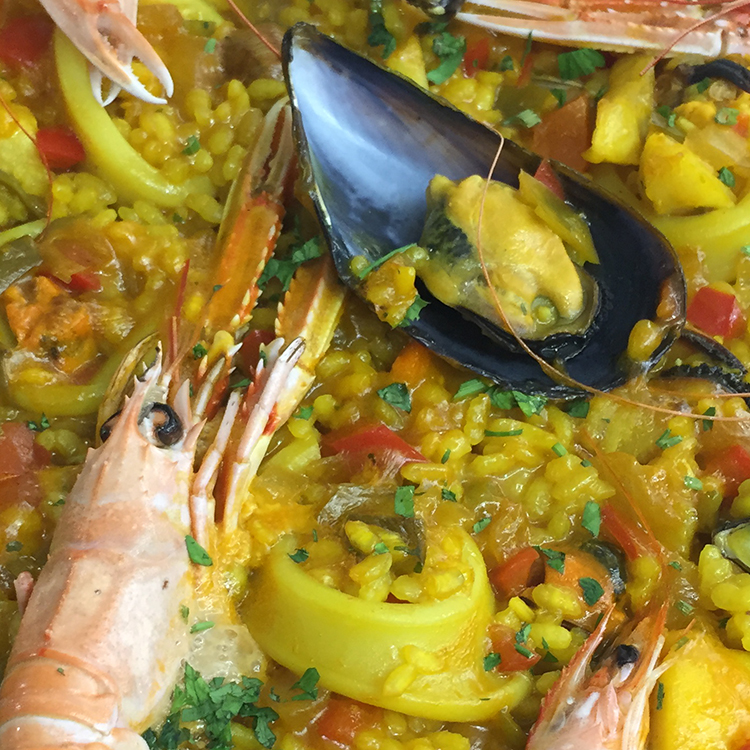
Nu kommer det in en tapas. Det är inget jag beställt, det är servitörens och kökets val av vad de tycker är lämpligt tilltugg till min dryck. Här sållas agnarna från vetet; en del ställen serverar pliktskyldigast en bit korv eller en ost, vilken som helst. Andra serverar med stolthet en speciell sorts korv eller ost, och på en del ställen får jag in Higaditos - sherrystekt kycklinglever - eller musslor i en mustig tomatsås.

Om nu både vinet och min tapas var riktigt bra, så är det lätt att jag stannar kvar en stund till eller kommer tillbaka inom kort. Kanske börjar jag snegla på vad de andra har fått för tapas, för man får inte samma till andra eller tredje glaset. När vi pratar Content Marketing skulle detta kunnas liknas vid det sätt som företag använder sig av remarketing - de skickar samma digitala budskap om och om igen. Nej, jag vill inte ha samma tapas om och om igen, jag vill bli frestad på nytt! Jag beställer in ett glas till - är jag supernöjd med det jag fick, blir det samma vin, annars ber jag om en rekommendation - ett bra sätt att lotsa kunden.

Nästa tapas kommer in, och om det känns lite oklart vad jag vill symbolisera med tapas, så är det våra digitala möten med blivande kunder. Vi vill leverera något som passar målgruppen, något vi är stolta över och kan stå för. Om vi har läst vår kund rätt, så har vi tagit ett steg i rätt riktning för att locka kunden tillbaka, och kanske också att välja att äta sin middag där.
I det här fallet blir middagen målet för vår kundresa, alltså den produkt eller tjänst vi vill sälja, men det är absolut inte slutet på vår relation. När jag betalat min middag och förhoppningsvis är väldigt nöjd, så får jag också in ett litet glas hemmagjord likör, allt för att fira vår relation. Jag får också ett visitkort – en liten uppmuntran att ta kontakt igen.

Har restaurangen levererat, är chansen stor att jag förmedlar detta via Facebook eller Instagram. Jag har säkert också recenserat besöket på några sidor, och om personalen är vaken, går de in och tackar för mina recensioner. Nu börjar andra kunders resa mot målet och när de ser min recension och personalens respons,  blir de kanske nyfikna på vad jag har recenserat innan. Om de då hittar något annat ställe som de också har en relation till, så är chansen stor att de väljer samma restaurang för sitt nästa besök.

Om det nu är så här enkelt så borde väl alla göra det? Ja det kan man tycka. Men alla har inte samma ambitioner eller kunskapsnivå, alla värderar inte kunder på samma sätt och väldigt många har inte kunskap eller insikt om vem de söker som kund med sitt erbjudande. 

Därför är det så viktigt att lära känna våra kunder och förstå deras intressen. Det innebär också att vi måste våga ta steget och inse att alla inte är våra kunder. Vi måste vårda våra kontakter när vi skickar mail och när vi skickar ut innehåll i andra digitala kanaler. Framförallt måste vi vara oerhört bra på att tala om vad vi är och vad vi vill att kunderna ska förvänta sig efter att ha besökt vår hemsida.

Jag hoppas det här med Content Marketing blev lite klarare eller åtminstone gav dig inspiration att ta dig och ditt företag ett steg närmare dina kunder digitalt. Gör du rätt, så är det här oerhört effektivt, och dina kunder kommer att vara en stor del av ditt fortsatta arbete, både vad gäller kommunikation och produktutveckling.

Buen apetito!

Aludd

Vill du veta mer om IHM Content & Marketing Management? Boka rådgivning

PS Det ligger naturligtvis också en hel del tekniska finesser bakom ett bra content-arbete men det berör vi inte här.  Att mäta kundernas respons på restaurangen kan man göra genom att fråga. I en digital kundresa går det också att göra, men framförallt handlar det om att se och mäta hur kunderna rör sig på din hemsida.

31 oktober 2017
Strategi, taktik, träning och verktyg. Läs mer

Vill du ha vårt nyhetsbrev?

Tyvärr, formuläret är inte tillgängligt.
Emma Anderberg, marknadsansvarig på Netrelations
Johanna vågade satsa på sin dröm